
Skip Hire Cost UK: Sizes, Prices, Permits and What You Cannot Put In
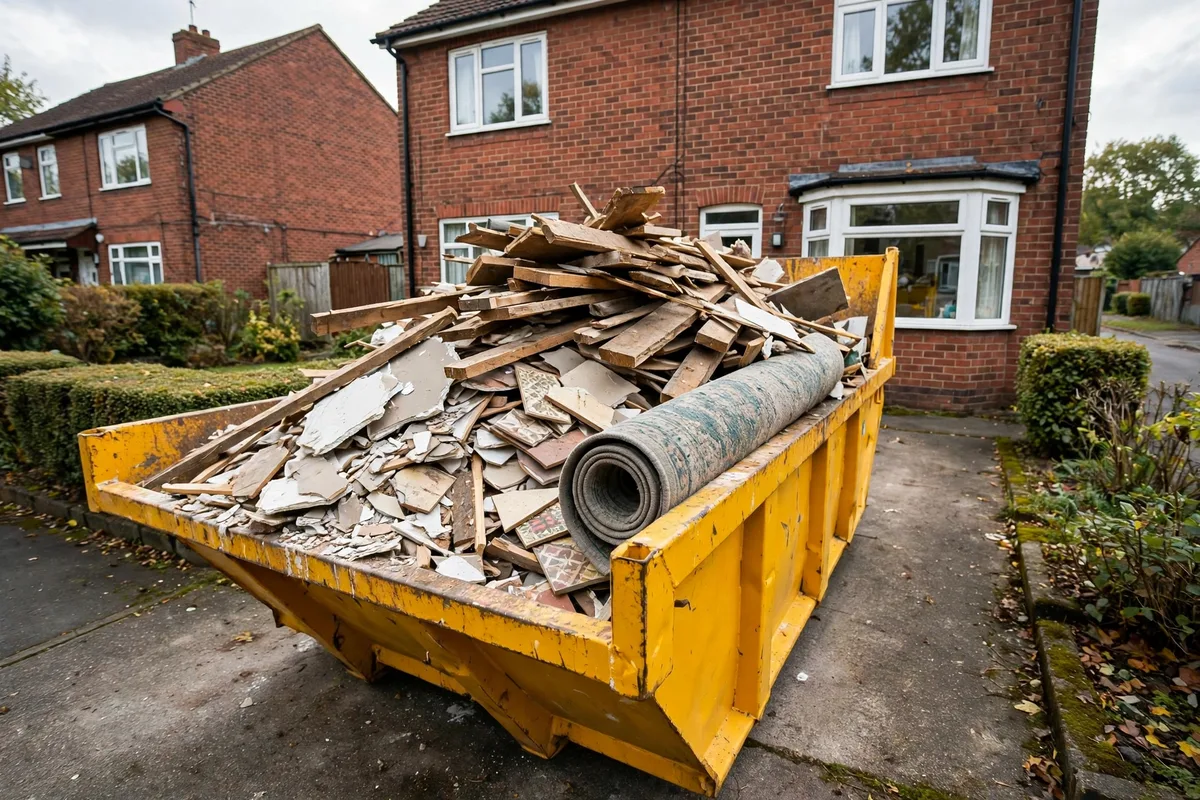
A skip is the simplest way to clear renovation waste, but it is also one of the easiest things to get wrong. Hire one too small and you pay twice: once for the skip that overflowed, and again for the second skip or the man-and-van call to finish the job. Hire one too big and you have paid for empty air. Order the wrong type for heavy waste and the driver can refuse to take it. Put the wrong items in and you face extra charges, or the skip is left on your drive.
This guide is built around the decision in the order you actually make it. First, match the skip to the job you are doing. Then check the size and the price. Then sort out whether you need a road permit. Then check what cannot go in. It covers the standard UK skip sizes in plain English, typical hire prices by size, permit fees and rules, the banned-items list, how long you get the skip for, and the cheaper alternatives for small jobs.
Skip Sizes in Plain English
Skip sizes are measured in cubic yards, written as “yard” skips. A cubic yard is roughly the size of a large wheelie bin multiplied by about five, or about ten black bin bags. The number that matters is not the volume alone but what the skip can hold in practice, because a skip filled level with the rim holds far less than its nominal volume suggests when the waste is bulky.
Start with the job, not the size. The table below matches common renovation jobs to the skip size that usually fits them, with the caveat that heavy waste changes the answer: soil, rubble, bricks and concrete are so heavy that they are legally restricted to skips of 8 yards or smaller, so a large skip full of rubble is not an option at any price.
| Job | Skip size that usually fits | Rough equivalent |
|---|---|---|
| Bathroom strip-out (suite, tiles, plaster) | 4 to 5 yard midi | About 40 to 50 bin bags |
| Kitchen rip-out (units, worktops, flooring) | 6 to 8 yard builder’s | About 60 to 80 bin bags |
| Garden clearance (soil, turf, branches) | 4 to 8 yard, heavy-waste limit applies | About 40 to 80 bin bags |
| Single room renovation (plaster, flooring, furniture) | 6 to 8 yard builder’s | About 60 to 80 bin bags |
| Full house renovation or extension | 8 yard, or two 8 yard skips in sequence | About 80 bin bags per skip |
| Small clear-out (garage, loft, one room of junk) | 2 to 3 yard mini | About 20 to 30 bin bags |
The sizes themselves break down like this.
Mini skip, 2 to 3 yards. The smallest skip you can hire, about the size of a large wheelie bin multiplied by ten. It suits a small clear-out, a garage tidy, a small bathroom strip-out if there is no heavy rubble, or a garden tidy of light green waste. It fits on most driveways and is the cheapest option, but it fills fast: a single room of bulky furniture will overfill it.
Midi skip, 4 to 5 yards. The middle size, and the most common choice for a bathroom strip-out or a medium clear-out. It holds roughly twice a mini skip and still fits on a standard driveway. If you are stripping a bathroom, the suite, the tiles and the old plaster usually fit in a 4 yard skip, provided the tiles are bagged and the waste is broken down rather than thrown in whole. If you are stripping a bathroom, our guide to how to regrout bathroom tiles covers the smaller bathroom jobs that do not need a skip at all.
Builder’s skip, 6 to 8 yards. The standard skip on UK building sites, and the right size for a kitchen rip-out or a single-room renovation. An 8 yard skip is the largest size that can legally carry heavy waste such as soil, bricks and rubble, which is why builders use it for strip-outs. It needs a driveway or a road space of about 3.7 metres long, so measure before you order. If you are replastering after a strip-out, our guide to how to plaster a wall for beginners explains the patch-first method for the walls the skip has just cleared.
Maxi skip, 10 to 12 yards. The largest commonly hired skip, for light bulky waste only: furniture, wood, packaging, insulation and general renovation waste. A 12 yard skip cannot take heavy waste, so it is the wrong choice for a garden dig-out or a brick wall demolition. It also needs more space to sit and a larger lorry to deliver, so check access before you book.
Roll-on roll-off skips, 20 to 40 yards. These are commercial skips for large construction sites, not domestic hires. They need a lorry with a roll-on mechanism, a wide access road, and usually a commercial waste arrangement. If a domestic hire company offers you one, you are almost certainly hiring too big.
One rule covers every size: a skip must be filled level with the rim, not heaped above it. An overfilled skip is unsafe to transport, and the driver is entitled to refuse it or charge a surcharge of roughly £10 to £40 to level it off. Break waste down before it goes in. Flat-pack furniture, break up plasterboard, and stack timber flat rather than throwing it in at angles, and the same skip will hold noticeably more.
Typical Skip Hire Prices in the UK
Skip hire prices are quoted per hire, not per day, and the price usually includes delivery, collection, and disposal of the waste at a licensed facility. The figures below are typical ranges from Checkatrade’s cost guide, updated in June 2026, and MyJobQuote’s cost guide, updated on 3 November 2026. They agree in band, and they are indicative ranges, not quotes: your price depends on size, location, the type of waste, and how long you keep the skip.
| Skip size | Typical price range | Typical average |
|---|---|---|
| Mini, 2 to 3 yard | £75 to £175 | About £125 |
| Midi, 4 to 5 yard | £130 to £320 | About £225 |
| Builder’s, 6 to 8 yard | £190 to £450 | About £320 |
| Maxi, 12 yard | £220 to £440 | About £330 |
Overall, most domestic skip hires in the UK fall between about £75 and £450, depending on size, location and hire period. The spread within each size is wide because location matters so much: London typically costs £50 to £350 more than the north of England for the same skip. A 2 to 3 yard mini skip in London typically costs £135 to £175, while an 8 yard builder’s skip in London typically costs £330 to £450. Outside London and the South East, the same sizes sit at the lower end of the ranges above.
Four things push the price up beyond the headline figure.
Waste type. Mixed general waste is the standard price. Heavy waste such as soil and rubble is often charged differently because disposal is priced by weight, and plasterboard is sometimes charged as a separate stream because it cannot go to landfill with general waste. Tell the hire company exactly what is going in, and get the price for that waste type, not for a generic skip.
Location and access. A skip delivered to a narrow street, a steep drive, or a property that needs the lorry to reverse a long way can cost more, and some companies add a charge if the driver has to wait. A skip on a private driveway is the cheapest arrangement because there is no permit to pay for.
Permit fees. If the skip sits on a public road, pavement or verge, you need a council permit, and the permit fee is usually added to the hire price or charged separately. Permit fees are covered in detail below.
Extras. A lockable skip, which stops other people dumping their waste in yours overnight, typically adds £50 to £150. Extra days beyond the standard hire period typically cost £5 to £20 a day. Weight overage, where the skip exceeds the agreed weight limit, is typically charged from about £20 a tonne. Overfilling, covered above, typically adds £10 to £40.
The honest way to buy a skip is to get two or three quotes from local hire companies and compare them on the same basis: same size, same waste type, same hire period, and permit included or excluded stated clearly. A quote that looks much cheaper than the rest usually excludes the permit or the VAT, so check both before you compare. Always get a local quote for your job; no national average is a substitute for one.
Road Permits and Lights
You only need a permit if the skip sits on public land: a public road, a pavement, or a grass verge owned by the council. If the skip sits entirely on your private driveway or private land, no permit is needed, and this is the cheapest and simplest arrangement. If any part of the skip overhangs the pavement or the road, the permit rule applies.
The permit is normally arranged by the skip hire company, not by you. The company applies to the local council, pays the fee, and adds it to your bill, or charges it separately. Ask when you book whether the permit is included in the quoted price, and which council the company is applying to, because the fee varies by council.
Permit fees typically range from £15 to £70, and commonly sit between £30 and £60. Some London boroughs charge more than that range, so a London permit can be the single largest extra on a small skip hire. A permit is usually valid for 7 to 14 days, which matches the standard hire period. If you need the skip for longer, the permit may need to be renewed, and the renewal fee is usually charged again, so plan the job to finish inside the permit window.
There are two more rules that apply to skips on the road. The skip must have reflective markings and, at night, warning lights on its corners, so that drivers can see it. The hire company normally supplies these, but confirm it when you book, because a skip on a public road without lights is a hazard and can be reported to the council. The skip must also be placed so that it does not block a pavement entirely or obstruct a driveway, a junction, or a fire hydrant. The hire company will know the local rules, but the legal responsibility for a skip on the road sits with the person who hired it, so it is worth checking the placement yourself before the driver leaves.
If your driveway is too small or too steep for a skip, and the road is your only option, budget for the permit as part of the job cost from the start. A £30 to £60 permit on a £125 mini skip is a large percentage increase, and it is the most common reason a skip hire ends up costing more than the homeowner expected.
What You Cannot Put in a Skip
Not everything can go in a skip, and the banned list is longer than most people expect. Putting a banned item in a skip can mean the driver refuses to collect it, or the hire company charges extra to remove the item separately. The rules exist because some waste is hazardous, some needs specialist disposal, and some is illegal to send to landfill.
Never put in a skip:
- Asbestos. Asbestos-containing materials, including old roof sheets, pipe lagging, floor tiles and garage roofs, are hazardous waste. They need a licensed asbestos removal contractor and a separate consignment. If you suspect asbestos, stop and get it tested before you touch it.
- Paints, solvents, oils and chemicals. Liquid paint, thinners, solvents, engine oil, petrol, and garden chemicals are hazardous waste and must go to a household waste recycling centre that accepts them, or to a specialist collection.
- Fridges and freezers. These contain refrigerant gases that must be recovered by a licensed handler. Most councils collect them separately, and many retailers take the old one away when they deliver a new one.
- Televisions, computers and monitors. Electrical waste is covered by the WEEE regulations and must be recycled separately. A skip company can be fined for taking it, so they will not.
- Tyres. Tyres cannot go to landfill and are not accepted in skips. Tyre fitters and recycling centres take them.
- Batteries. Car batteries and household batteries contain lead and acid. Take them to a recycling centre or a retailer that accepts them.
- Gas cylinders and gas bottles. Pressurised containers are a fire and explosion risk in a waste lorry. Return them to the supplier or take them to a recycling centre that accepts them.
- Plasterboard in mixed waste. Plasterboard cannot go to landfill with general waste because it produces hydrogen sulphide gas when it breaks down. Some skip companies accept it as a separate, segregated load for an extra charge; others refuse it entirely. Tell the hire company in advance if you have plasterboard, and keep it separate from the rest of the waste.
- Mattresses. Many skip companies charge extra for mattresses, and some refuse them, because they are bulky and hard to process. Ask before you load one in.
- Medical waste and clinical waste. Anything sharps, medicines or clinical waste needs a specialist collection, never a skip.
Usually fine in a skip: general household waste, wood, metal, bricks and rubble (in an 8 yard skip or smaller), soil, turf, garden waste, tiles, ceramics, old furniture, carpets, plaster (not plasterboard), and packaging.
If you are unsure about an item, ask the hire company before you load it. A two-minute phone call is cheaper than a refused collection or an extra charge, and the company would rather answer the question than find the item at the weighbridge. Also remember your duty of care: you are responsible for making sure your waste goes to a licensed carrier, so check that the hire company holds a waste carrier licence and ask for a waste transfer note or a receipt if you want proof of where the waste went.
How Long You Get a Skip For
The standard hire period in the UK is one to two weeks, and that is included in the quoted price. For a renovation job, a hire period of two to four weeks is common, because the strip-out, the structural work and the clear-up rarely finish in a single week. Check the hire period when you book, because it varies by company, and because keeping a skip longer than the agreed period costs extra, typically £5 to £20 a day.
The practical rule is to order the skip for the day the waste is ready, not for the day the job starts. A skip that arrives on Monday and sits empty until Thursday wastes three days of hire period and invites neighbours to fill it. If the job is a strip-out, book the skip for the morning of the strip-out, have the waste ready to load the same day, and aim to have it full and collected within a few days.
If the job runs over, call the hire company before the hire period ends. Most companies will extend the hire for a daily charge, and extending in advance is cheaper and simpler than having the skip collected half-full and reordered. If the permit is about to expire, the extension may also need a permit renewal, so check both dates together.
One more timing point: do not book a skip for a weekend and assume it will be collected on Monday. Collection is usually on a working day, and a skip left on the road over a weekend without a valid permit, or with a permit that has expired, can be reported to the council. Confirm the collection day when you book, and confirm it again the day before.
Cheaper Alternatives: Hippo Bags and Man-and-Van
A skip is not always the cheapest way to clear waste, and for small jobs it is often the most expensive. Two alternatives cover most small and medium clearances, and they are worth pricing before you order a skip.
Hippo bags and skip bags. A skip bag is a heavy-duty woven bag, usually about 1 cubic yard, that you fill yourself and have collected by lorry with a crane. The bag itself typically costs £10 to £30, and collection typically costs £100 to £200 depending on size and location, so the total is usually less than a mini skip for the same amount of waste. Skip bags suit jobs where a skip cannot fit, such as a narrow driveway or a flat with no road access, because the bag can be placed in a garden or on a pavement and collected later. They also suit slow jobs, because there is no hire period: you fill the bag when you are ready, and you book the collection when it is full. The same banned-items list applies, and the bag must be placed where the crane lorry can reach it, with no overhead cables or branches in the way.
Man-and-van waste clearance. A licensed man-and-van service typically charges £50 to £200 for a small load, depending on volume and location, and £150 to £400 for a larger load. For a single room of bulky furniture or a garage clear-out, it can be cheaper than a skip, and it has two advantages a skip does not: the crew loads the waste for you, and there is no skip sitting on your drive or road for a week. The risk is that unlicensed operators exist, and an unlicensed operator who fly-tips your waste leaves you legally responsible for it. Check that the operator holds a waste carrier licence, ask for a waste transfer note, and be suspicious of any price that is far below the rest: a legitimate operator pays disposal fees at a licensed site, and those fees set a floor under the price.
When a skip still wins. For a full renovation, a kitchen rip-out, or a job that produces waste over several days, a skip is usually the cheapest option per cubic yard, because you pay once and fill it as the work progresses. If you are planning a larger renovation and want to understand the costs involved, our guide to cavity wall insulation cost in the UK covers one of the bigger energy-efficiency jobs that often runs alongside a renovation, and the same logic applies: price the job, then price the waste clearance, and compare the totals before you commit.
Frequently Asked Questions
How much does skip hire cost in the UK?
Most domestic skip hires cost between about £75 and £450, depending on size, location and hire period. A 2 to 3 yard mini skip typically costs £75 to £175, a 4 to 5 yard midi skip £130 to £320, a 6 to 8 yard builder’s skip £190 to £450, and a 12 yard maxi skip £220 to £440. London prices are typically £50 to £350 higher than the north of England. These are indicative ranges from Checkatrade, updated June 2026, and MyJobQuote, updated 3 November 2026, not quotes. Always get a local quote for your job.
What size skip do I need for a bathroom?
A 4 to 5 yard midi skip usually fits a bathroom strip-out: the suite, the tiles and the old plaster. If the bathroom has a lot of heavy rubble, keep to an 8 yard skip or smaller, because heavy waste is legally restricted to skips of 8 yards or less. Break tiles and plaster down before loading, and bag loose rubble, so the skip holds more.
Do I need a permit for a skip on my driveway?
No. You only need a permit if the skip sits on public land: a road, a pavement or a council-owned verge. If the skip sits entirely on your private driveway or private land, no permit is needed. If any part of it overhangs the pavement or the road, the permit rule applies, and the fee is typically £15 to £70, commonly £30 to £60.
Can I put soil in a skip?
Yes, but only in a skip of 8 yards or smaller, because heavy waste is restricted to those sizes. Soil is heavy, so a small skip fills by weight long before it fills by volume. Tell the hire company that the load is soil, because it may be priced differently from mixed general waste.
Can I put plasterboard in a skip?
Only if the hire company agrees in advance, and usually only as a separate segregated load for an extra charge. Plasterboard cannot go to landfill with general waste, so many companies refuse it in a mixed skip. Keep plasterboard separate from the rest of the waste and ask the company before you load it.
How long can I keep a skip?
The standard hire period is one to two weeks, included in the quoted price. For renovation jobs, two to four weeks is common. Keeping a skip longer typically costs £5 to £20 a day, and a road permit may need renewing as well, so plan the job to finish inside both windows.
What happens if I overfill a skip?
The driver can refuse to collect it, or charge a surcharge of roughly £10 to £40 to level it off. A skip must be filled level with the rim, not heaped above it, because an overfilled skip is unsafe to transport. Break waste down and stack it flat so the same skip holds more.