
Cavity Wall Insulation Cost UK: Prices, Suitability and Grants
Cavity wall insulation is one of the cheapest ways to make a UK home warmer, and also one of the easiest to get wrong. Done on the right house it pays for itself in a few years and cuts heat loss through the walls by roughly a third. Done on the wrong house it can trap moisture, make damp worse and cost thousands to remove. The price is only half the question. The first question, the one most cost guides skip past, is whether your wall should be filled at all.
This guide starts there. It explains how to check whether your home has a cavity and whether it is suitable, then sets out what cavity wall insulation typically costs by house type and by material, what you can expect to save, the damp question answered honestly, which grants are actually open in 2026, and the 25-year guarantee that should come with the work.
Is Your Wall Actually a Cavity Wall?
Most UK homes built from the 1920s onwards have cavity walls: two separate leaves of brickwork, an outer leaf and an inner leaf, with a gap between them of around 50mm or more. Homes built before about 1920 usually have solid walls, a single thick leaf of brick, and no cavity to fill. If your house is solid-walled, cavity insulation is not an option at all, and the right job is solid wall insulation, which is a different project with a different price.
Age is the quickest clue, but it is not proof. A 1930s semi is very likely cavity-walled. A Victorian terrace is very likely solid. Homes built in the 1970s and 1980s almost always have cavities, and many already have some insulation in them, which changes the maths entirely. The only way to be sure is a borescope survey, where the installer drills a small hole and looks inside the cavity with a camera. A reputable installer does this before quoting, and any quote given without it is a guess.
The brick pattern gives a useful hint before the survey. Look at the outside wall. If the bricks are laid in a regular pattern with all the long faces showing, known as stretcher bond, the wall is probably cavity. If you can see the short ends of bricks alternating with long faces, known as English bond or Flemish bond, the wall is probably solid, because those short ends are header bricks tying the two leaves together. It is a guide, not a diagnosis, and it is worth checking at the front and the back of the house, since extensions and repairs can differ.
Cavity width matters too. The gap needs to be at least 50mm wide for most insulation materials to work properly. Narrower cavities can sometimes be filled with specialist materials, but the benefit shrinks and the risk rises, and many installers will decline the job. The survey measures the width and also checks for rubble in the cavity, leftover mortar and bricks dropped during construction, which can bridge the gap and carry damp across. A cavity full of rubble is not a good candidate for filling until it is cleared, and clearing it is rarely worth the cost.
When Cavity Wall Insulation Is NOT Suitable
Some homes should not have their cavities filled, whatever the price. The most important exclusion is exposure. A house on an exposed hill, on the coast, or in an area that takes driving rain on its windward side is at higher risk, because filled insulation can give rainwater a path across the cavity to the inner wall. The same applies to walls that are already damp, walls with cracked or porous brickwork, and walls where the pointing has failed. Filling a cavity in a wall that already lets water in does not fix the water; it gives the water somewhere to sit.
Other red flags are easier to spot. If the house is in a flood-risk area, if the cavity already contains insulation that has slumped or got wet, or if the property is a flat where the cavity is shared with neighbours, the job needs specialist advice before anyone drills a hole. Timber-framed homes are a separate case entirely, and their insulation is done differently. Listed buildings and homes in conservation areas may need consent, and the insulation material and method may be restricted.
This is also where the sales pressure test comes in. Cavity wall insulation is a quick job, usually finished in a day, and it has been sold aggressively in the past, including to homes that were never suitable. An installer who quotes a price from the doorstep, who will not do a borescope survey, or who pushes you to sign on the spot is a reason to get a second opinion. The survey is free from reputable firms, it takes under an hour, and it is the single most important step in the whole process. If the survey says no, believe it: the cost of removing failed insulation and repairing damp runs into thousands, and it is not covered by the guarantee if the house was unsuitable in the first place.
What Cavity Wall Insulation Costs
If the survey says yes, the price depends mainly on the size of the house, the material chosen, and where you live. The guides checked for this article disagree widely on price, and that disagreement is itself useful: it shows how much quotes vary with wall area, access, and region. Treat every figure here as a typical range, not a quote, and get at least two written quotes for your own home before deciding.
For a mid-terrace house, typical private costs run from around £600 to £1,800. A semi-detached house typically costs £1,000 to £2,700, with Checkatrade putting a semi at around £2,700 at the top end and smaller cost guides starting nearer £1,000. A detached house typically costs £1,500 to £4,600. Overall, the range most guides converge on is roughly £600 to £3,000 for a typical home, with Checkatrade’s dedicated guide going up to £4,600 and MyJobQuote reporting an average of around £2,500 with a range of £1,000 to £5,000. The spread is wide because the price is driven by the area of wall to be filled, and a three-bedroom detached house has far more external wall than a two-bedroom terrace.
Per square metre, installed prices typically run from £13 to £30, depending on the material. Mineral wool is usually the cheapest at around £13 to £22 per square metre. Expanded polystyrene beads, known as EPS beads, typically cost £18 to £25 per square metre. Polyurethane foam typically costs £22 to £30 per square metre, and one Checkatrade line puts it as high as £65 in some cases. The per-metre figure is the one to compare between quotes, because it strips out the effect of house size and lets you see whether one installer is genuinely cheaper or simply measuring a smaller wall area.
What pushes the price up is usually access and condition, not the material. Scaffolding adds cost if the upper walls cannot be reached from a ladder. A house with a large wall area, bay windows, or an awkward shape takes longer. London and the South East typically cost more than the North and Wales, as with most trades. And if the survey finds rubble in the cavity or existing insulation that needs removing first, the job becomes a different, more expensive one, or it may not go ahead at all.
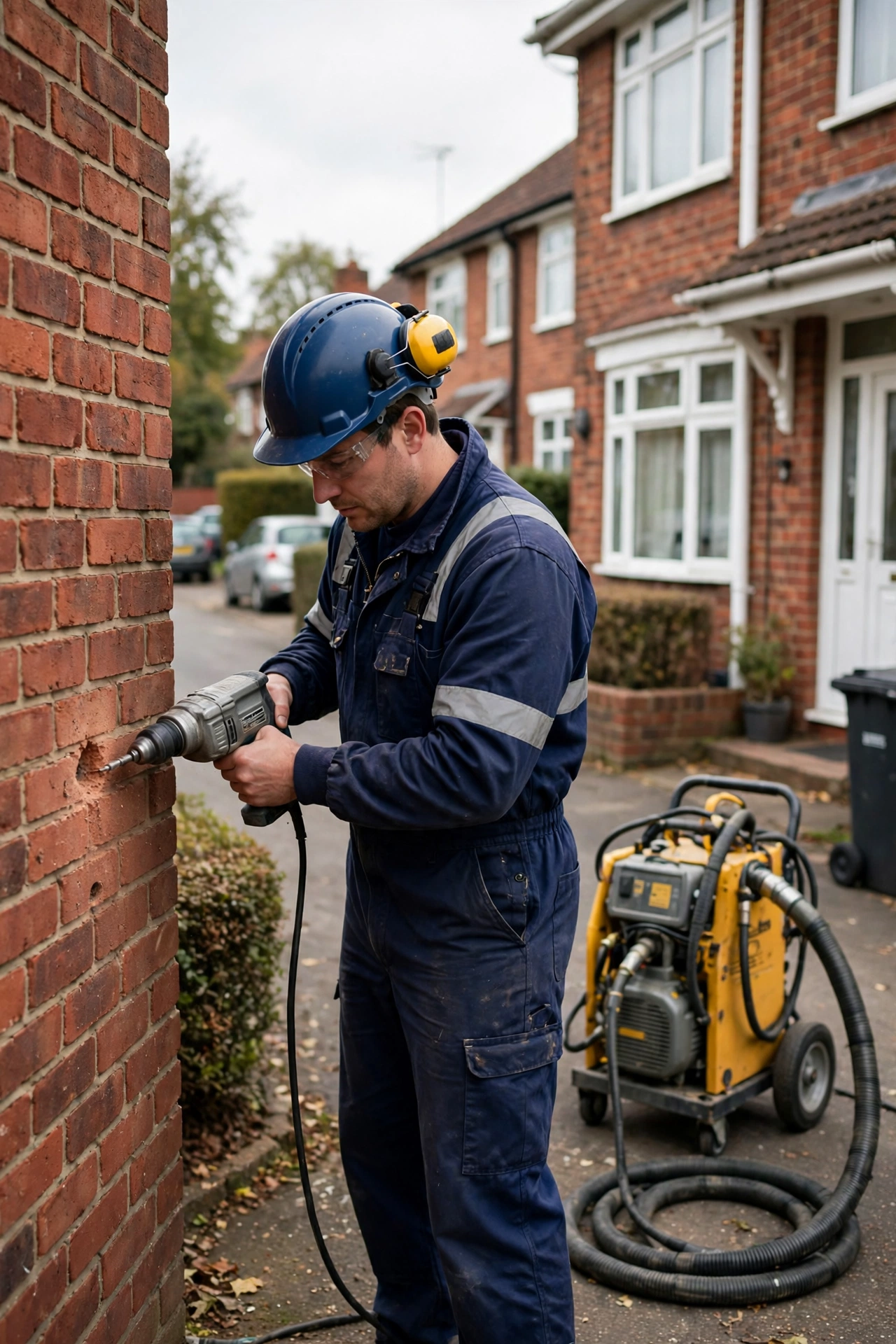
Installation itself is fast. Most jobs take two to six hours and are finished in a single day, with the installer working from outside the house. Small holes are drilled in the outer wall in a regular pattern, the insulation is blown or injected in, and the holes are filled and matched to the brickwork. There is little disruption inside the home, and you do not need to move out. The holes should be barely visible afterwards; if they are not, that is a workmanship issue to raise before you pay the final balance.
Materials Compared
Three materials dominate the UK market, and they behave differently in a wet wall, which is why the choice matters more than the price gap between them.
Mineral wool is the most common and usually the cheapest. It is made from spun rock or glass, it does not burn, and it is blown into the cavity as a loose fill. It insulates well and it is the material most installers have the most experience with. Its weakness is water: if it gets wet it can slump and lose performance, which is why it is the wrong choice for a wall that already has a damp problem.
EPS beads are small expanded polystyrene beads, blown in with an adhesive that bonds them lightly together. They do not absorb water, so they perform better than mineral wool in a wall that gets wet, and they flow well around obstructions in the cavity. They cost more than mineral wool, and they are the usual recommendation where the survey finds a cavity that is sound but in an exposed position.
Polyurethane foam is injected as a liquid that expands to fill the cavity completely, including around pipes and wires. It gives the best thermal performance per millimetre and it seals the cavity well, which is why it is often chosen for narrow cavities. It is the most expensive of the three, and it is the hardest to remove if anything goes wrong, so the suitability survey matters even more with foam than with the other materials.
There is no single best material for every house. The right choice depends on the cavity width, the exposure of the wall, and what the survey finds inside. An installer who recommends one material for every job is selling a product, not solving your problem. Ask what the survey found and why the recommended material fits it.
The Damp Question, Answered Honestly
The fear that cavity wall insulation causes damp is the reason many homeowners hesitate, and it is not baseless. Insulation can cause damp, but only when it is installed in the wrong house. In a suitable home, with a sound outer wall and a clean, dry cavity, filled insulation does not cause damp. In an unsuitable home, with cracked brickwork, failed pointing, or an exposed position, it can give rainwater a bridge across the cavity and make an existing damp problem worse.
The honest way to think about it is that insulation does not create water. It can only move water that is already getting in. That is why the survey and the condition of the outer wall matter so much, and why the guarantees are written the way they are. If your home already has damp, fix the damp first. Repoint the wall, repair the brickwork, sort the gutters, and only then think about filling the cavity. Our guide to the types of damp in a house explains how to tell condensation, rising damp and penetrating damp apart, and which one you are actually dealing with, because the treatment is different for each.
There is one more damp-related point worth knowing. Filling the cavity makes the inner wall warmer, which reduces condensation on cold walls. For many homes that is a genuine bonus, and it is one of the reasons the Energy Saving Trust includes cavity wall insulation in its standard advice. But it is not a cure for condensation caused by poor ventilation. If the house has a condensation problem, insulation helps the symptom and ventilation fixes the cause, and both may be needed.
What You Save, and How Long It Takes to Pay Back
The Energy Saving Trust figures quoted in the cost guides checked for this article put the annual saving for a gas-heated home at roughly £110 to £395 a year, with a semi-detached house saving up to around £395. The saving depends on the size of the house, how much wall area is insulated, what fuel you heat with, and how warm you keep the home. A large detached house heated with oil or LPG saves more in pounds than a small terrace on mains gas, because the fuel costs more per unit of heat.
Payback is where the guides disagree most, and they disagree because the maths depends on two numbers that vary widely: what you paid and what you save. Low-cost cases on a small house can pay back in one to four years. Higher-cost cases, where the price was at the top of the range and the saving at the bottom, can take seven to fourteen years. Do not let anyone quote you a single payback figure without showing both sides of the calculation. The honest version is a range, and your own range depends on your quote and your energy bills.
It is worth putting cavity wall insulation in context with the rest of the house. Loft insulation is usually cheaper and saves a similar amount, and it is worth doing first if the loft is not yet insulated to the recommended 270mm. Our guide to loft insulation cost in the UK sets out the prices and the grants for that job. Draught proofing and a well-serviced boiler matter too: a boiler that is not serviced wastes fuel whatever the walls are doing, and our guide to boiler service cost in the UK explains what a service should include and what it typically costs.
Grants in 2026: What Is Actually Open
Grant funding for cavity wall insulation has changed recently, and older articles are now out of date on this point, so check the date on anything you read.
The Great British Insulation Scheme, known as GBIS, closed on 31 March 2026. Any article or installer still describing GBIS as open funding is working from old information. ECO4, the Energy Company Obligation scheme, is open until 31 December 2026 and covers insulation for lower-income households, including cavity wall insulation where the home qualifies. The successor scheme in England is the Warm Homes Plan, delivered in part as the Warm Homes: Local Grant, which is council-run and aimed at lower-income households in homes rated EPC band D to G. One source puts its funding window to March 2028.
Eligibility for the current schemes is based on household income and the energy performance of the home, not on the age of the house alone, and the work must be done by an approved installer through the scheme. If you think you may qualify, the practical route is to check with your local council or an ECO4-approved installer, and to get the eligibility confirmed in writing before any work starts. Do not pay a deposit for grant-funded work until the funding is confirmed, and be wary of any firm that asks for payment upfront for a job it says is fully funded.
If you do not qualify for a grant, the private cost is the figure to budget for, and the ranges in this guide are the starting point. Some energy suppliers also run their own insulation offers from time to time, and it is worth asking yours, but supplier offers change frequently and should be checked at the time, not assumed.
The 25-Year Guarantee
Properly installed cavity wall insulation should come with a 25-year guarantee from the Cavity Insulation Guarantee Agency, known as CIGA, where the installer is registered with CIGA, or with an independent insurance-backed guarantee from another provider. The guarantee covers the insulation itself and the workmanship, and it is transferable if you sell the house, which matters for buyers and their mortgage lenders.
Check three things before the work starts. First, that the installer is registered with CIGA or another recognised guarantee provider, and that the guarantee will be issued in your name. Second, that the guarantee covers the specific material being installed in your home. Third, that you receive the certificate after the work, and keep it with the house paperwork. A guarantee that is never issued is worth nothing, and a firm that cannot tell you which guarantee applies is a firm to walk away from.
The guarantee does not cover damp caused by a pre-existing defect in the wall, or by a house that was unsuitable for filling in the first place, which is why the survey matters so much. It covers the insulation doing its job in a suitable home. That is the right way round: the survey protects you, the guarantee backs the work, and the two together are what separate a good installation from a costly mistake.
Frequently Asked Questions
How much does cavity wall insulation cost in the UK?
For a typical home, private costs usually run from around £600 to £3,000, with a mid-terrace at roughly £600 to £1,800, a semi-detached at £1,000 to £2,700, and a detached house at £1,500 to £4,600. Per square metre, installed prices are typically £13 to £30 depending on the material. Quotes vary widely with wall area, access and region, so get at least two written quotes.
How do I know if my house has a cavity wall?
Age and brick pattern give clues: homes built from the 1920s onwards usually have cavities, and stretcher bond brickwork suggests a cavity while header bricks suggest a solid wall. The only certain check is a borescope survey, where the installer looks inside the cavity with a camera. A reputable installer surveys before quoting.
Does cavity wall insulation cause damp?
Not in a suitable home. Insulation does not create water; it can only give rainwater a path across the cavity if the outer wall already lets water in. That is why the survey matters and why homes with cracked brickwork, failed pointing or severe exposure should not be filled. Fix existing damp first.
What grants are available for cavity wall insulation in 2026?
The Great British Insulation Scheme closed on 31 March 2026. ECO4 is open until 31 December 2026 for qualifying lower-income households. The successor in England is the Warm Homes Plan / Warm Homes: Local Grant, council-run, for lower-income households in EPC band D to G homes. Check eligibility with your council or an approved installer.
How long does cavity wall insulation take to install?
Most jobs take two to six hours and are finished in a single day, working from outside the house. Small holes are drilled in the outer wall, the insulation is blown or injected in, and the holes are filled to match the brickwork.
What is the 25-year CIGA guarantee?
It is a guarantee from the Cavity Insulation Guarantee Agency, issued where the installer is registered with CIGA, covering the insulation and workmanship for 25 years. It is transferable when you sell the house. Check the installer is registered and that you receive the certificate after the work.