
Types of Damp in a House: Causes, Signs and Treatment
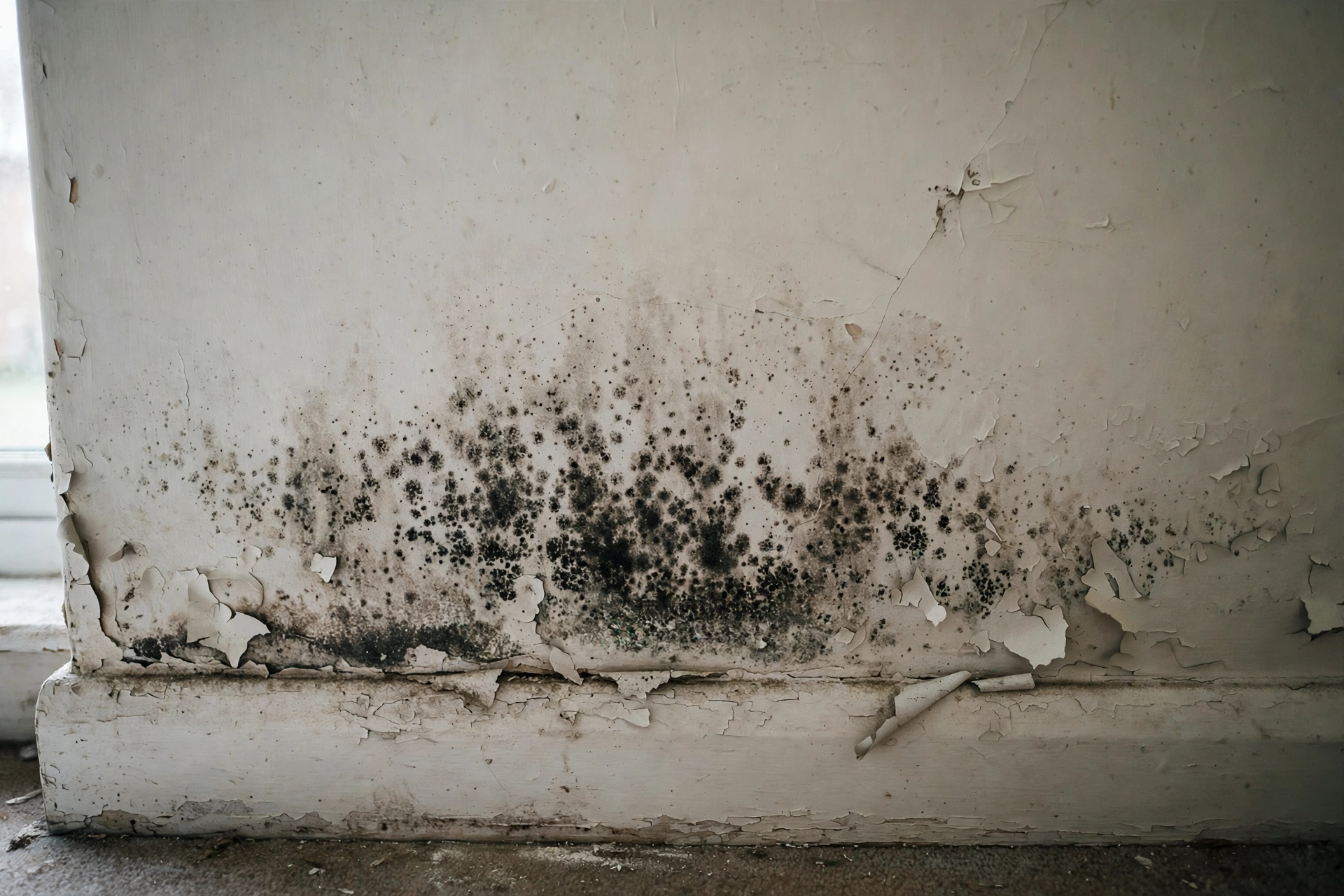
A damp patch on a wall is rarely just a damp patch. It is a symptom, and the treatment that fixes one kind of damp can be useless, or actively harmful, for another. Injecting a chemical damp-proof course into a wall whose real problem is condensation does not dry the house out. It hides the symptom behind new plaster for a few years while the moisture, the mould and the cause all carry on underneath.
That is why this guide starts with diagnosis, not treatment. In a UK house there are three main types of damp to separate: condensation, rising damp and penetrating damp. They look similar at first glance, a dark patch, peeling paint, a musty smell, but they arrive by different routes, they appear in different places, and they need different fixes. Once you can tell them apart, you can judge whether a quote makes sense, whether a DIY fix is realistic, and when you need an independent surveyor rather than a salesman with a treatment to sell.
The Three Types and How to Tell Them Apart
The quickest way to start is to ask three questions about the patch: where is it, when does it get worse, and what does it look like up close?
Condensation is moisture from inside the house. Everyday life puts water vapour into the air, from cooking, showering, drying clothes indoors and simply breathing, and that vapour condenses on the coldest surfaces it meets. It is worst in winter, when windows stay shut and the temperature difference between inside and outside is greatest. It appears on cold spots first: external walls, the corners of rooms, around windows, behind wardrobes pushed tight against an outside wall, and in bathrooms and kitchens with poor ventilation. The signs are surface mould, often black spots, water droplets, a musty smell, and paint or wallpaper that peels from the surface rather than crumbling from within the wall.
Rising damp is moisture from the ground travelling upwards through brickwork and plaster by capillary action, the same way water climbs up a sponge. It is limited in height, typically up to about one metre above ground level, because gravity and evaporation set a limit on how far it can climb. It appears at the bottom of ground-floor walls, usually as a horizontal band or tide mark, with salts left behind as the water evaporates. The plaster may blister, the paint may peel, and the skirting boards may rot, but the damp does not climb to the ceiling, and it does not appear on upper floors unless the cause is something else entirely.
Penetrating damp is water coming in from outside through a defect, sideways through the wall rather than upwards from the ground or downwards from the air inside. It can appear at any height, and it is linked to weather: it gets worse after rain, or after a specific event such as a blocked gutter overflowing. The patch is often localised, tied to one feature on the outside of the house, such as a leaking gutter, a cracked render, failed pointing, a damaged roof valley, or a parapet wall. Unlike condensation, it is not tied to how the room is used, and unlike rising damp, it is not confined to the bottom of the wall.
| Clue | Condensation | Rising damp | Penetrating damp |
|---|---|---|---|
| Main source | Moisture from inside the house | Groundwater rising through masonry | Rainwater entering through an external defect |
| Typical height | Any cold surface, often corners and external walls | Bottom of ground-floor walls, up to about 1 metre | Any height, often tied to one external feature |
| Worse when | Cold weather, windows shut, rooms steamed up | Persistent, with little seasonal change in the patch itself | After rain, or when a gutter or roof defect overflows |
| Typical signs | Black spot mould, droplets, musty smell | Tide mark, salts, blistering plaster, rotting skirting | Localised stain, often with a clear outside cause |
| First fix | Ventilation, heating, surface treatment | Repair or replace the damp-proof course, plus replastering | Fix the outside defect first, then dry and repair inside |
That table is a starting point, not a diagnosis on its own. Real houses mix causes: a wall can suffer from penetrating damp through failed pointing and condensation on its cold surface at the same time, and a high external ground level can bridge a damp-proof course and mimic rising damp. The sections below take each type in turn so you can check the pattern against your own house before anyone quotes for treatment.
Condensation Damp
Condensation is the most common type of damp in UK homes, and it is also the most misunderstood, because it is treated as a building fault when it is usually a balance problem between moisture, ventilation and heating.
A typical household produces a surprising amount of water vapour every day. Cooking a meal, taking a shower, drying a load of washing indoors and four people breathing overnight can add several litres of moisture to the air. In a warm, well-ventilated house that vapour is carried away. In a cold, tightly sealed house it has nowhere to go, so it condenses on the coldest surface available. That is usually an external wall, a single-glazed window, a thermal bridge where a concrete lintel or a steel beam passes through the wall, or the inside of a wardrobe that blocks warm air from reaching the wall behind it.
The signs are distinctive once you know them. Condensation damp shows as black spot mould, often in corners, in a line along the top or bottom of an external wall, or behind furniture. Windows stream with water in the morning, especially in bedrooms. The mould returns after cleaning, because cleaning removes the growth but not the conditions that let it grow. Clothes in a wardrobe against an outside wall may feel damp, and the wall behind the wardrobe may be the worst patch in the room, because the furniture has insulated that section of wall from the warm room air and made it colder.
Two habits make condensation worse in winter, and both are understandable. The first is keeping the heating low and intermittent, so walls cool down overnight and stay cold through the day. A wall that is allowed to go cold becomes a condensing surface even at normal indoor humidity. The second is sealing a house against draughts without adding controlled ventilation. Draught-proofing is worth doing, and our guide to how to draught-proof your home for winter covers the windows, doors and loft hatch worth sealing, but sealing gaps while still drying clothes indoors and never opening a window or running an extractor fan traps moisture inside. Ventilation and draught-proofing have to be balanced: seal the uncontrolled gaps, then ventilate deliberately, through trickle vents, extractor fans and short bursts of window opening, rather than leaving a permanent cold draught.
For window condensation specifically, the window itself is only part of the story. The glass is the coldest surface in the room, so it condenses first, but the cause is the moisture level and the ventilation of the room as a whole. Our guide to how to stop condensation on windows works through the room-by-room habits that matter, from extractor fans in bathrooms to keeping bedroom doors and trickle vents open, and it is worth reading alongside this page if windows are your main symptom.
One warning about cleaning mould: bleach is not the best answer, even though it is the first bottle most people reach for. Bleach can lighten the colour of mould on a hard, non-porous surface, but on plaster and other porous materials it does not reliably kill the growth in the material, and it can leave the surface looking clean while the mould returns. Our guide on why bleach is not the best solution for household mould removal explains the safer cleaning approach and, more importantly, why cleaning without fixing the ventilation only buys a few weeks. If mould covers a large area, if anyone in the household has asthma or another respiratory condition, or if the mould keeps returning despite ventilation improvements, get advice before disturbing it further, since disturbing a large mould growth can spread spores through the house.
Condensation is usually the cheapest type of damp to fix, and that is a useful diagnostic clue in itself. If a quote runs into thousands of pounds for a problem that appears mainly in winter, mainly on cold surfaces, and mainly in rooms that are steamed up or poorly ventilated, pause and get a second opinion before committing. The fix for condensation is usually a combination of better ventilation, steadier heating, and targeted measures such as an extractor fan or a dehumidifier, not a chemical injection into the wall.
Rising Damp (and Why It Is Over-Diagnosed)
Rising damp is real, but it is far less common than the number of rising damp diagnoses would suggest, and that gap is the single most expensive trap in this whole subject.
Every house built after the late nineteenth century should have a damp-proof course, a horizontal barrier, originally slate or bitumen, now usually a plastic membrane, built into the wall at least 150mm above external ground level. Its job is to stop groundwater rising through the masonry. In older houses that barrier can fail, crack, or be bridged, meaning something gives water a route over or around it. Common bridges are external ground levels that have risen over the years, such as a patio, a path or a flower bed built up against the wall above the damp-proof course level, soil piled against the wall, a blocked air brick, or internal plaster that runs right down to the floor and carries moisture past the barrier.
True rising damp has a specific pattern. It affects ground-floor walls, it stops at roughly one metre high, it leaves a tide mark where evaporation is greatest, and it leaves hygroscopic salts, nitrates and chlorides drawn up from the ground, in the plaster. Those salts matter, because they attract moisture from the air even after the water source is stopped, which is why genuine rising damp treatment almost always includes removing the contaminated plaster and replastering with a salt-resistant render, not just injecting a chemical. A diagnosis that skips the salt test, that does not check the external ground level, and that does not look at whether the damp-proof course is bridged, is incomplete.
The reason rising damp is over-diagnosed is straightforward: it has a clear, sellable treatment. A firm that sells chemical damp-proof course injection has a reason to find rising damp, and a free survey from a firm that also quotes for the work is not an independent diagnosis. The same low-level patch that is labelled rising damp is very often condensation on a cold ground-floor wall, penetrating damp from a high external ground level or a leaking gutter, or a bridged damp-proof course that can be fixed by lowering the ground level or clearing an air brick for a fraction of the cost of injection. Several damp specialists and consumer guides make the same point: most low-level damp is not rising damp at all, and the most common fix is the cheapest one, removing the bridge.
That does not mean rising damp never happens. Solid-walled Victorian and Edwardian houses with a failed or absent damp-proof course, houses where the ground level has been raised around the whole property, and houses with a long history of ground-level water problems can genuinely suffer from it. The difference is in the evidence: a proper diagnosis checks the wall construction, tests for salts, measures moisture at different heights to confirm the one-metre pattern, checks the outside ground level and air bricks, and rules out condensation and penetrating damp first. If a surveyor cannot show you that evidence, treat the diagnosis as unproven.
Penetrating Damp
Penetrating damp is the most straightforward type to understand, because it has a physical cause on the outside of the house that you can usually find by looking.
Water enters through a defect in the external envelope: a blocked or leaking gutter that overflows down the wall, a cracked or missing roof tile, a failed flashing around a chimney or a roof valley, cracked render, open or crumbling mortar joints, a damaged parapet, or a window frame whose seal has failed. Once water is inside the wall, it travels sideways and downwards, so the internal stain may not line up exactly with the external defect. A leaking gutter at roof level can show as a damp patch halfway down the wall, and a failed parapet can show as damp on a ceiling below it. The patch is usually localised rather than spread across a whole wall, and it changes with the weather, getting darker or larger after heavy rain and drying back in a dry spell.
The diagnostic method is to work from outside in. Walk around the house in or just after rain, if it is safe to do so, and look at the gutters, downpipes, render, pointing and roofline above and around the internal patch. Check whether a gutter is overflowing, whether a downpipe is blocked or discharging against the wall, whether render is cracked or hollow, and whether pointing is open. Inside, check whether the patch is on the same side of the house as the suspect feature, and whether it appears at a height that matches a roof, gutter or parapet defect rather than ground level. A moisture meter reading that is highest near the external feature and falls away from it supports a penetrating damp diagnosis, while a reading that is uniform across a cold external wall points more towards condensation.
Penetrating damp is also the type where the order of work matters most. The outside defect must be fixed first, and the wall must be allowed to dry, before any internal replastering or redecoration. Plastering over a wall that is still being fed by a leaking gutter traps the water, and the new plaster will fail in the same place. Drying can take weeks, longer for a thick solid wall, and redecorating too soon is one of the most common reasons a penetrating damp repair appears to fail. A roofer, a gutter specialist or a pointing specialist is usually the right trade for the external fix, not a damp-proofing firm, and the internal repair is often a straightforward plastering job once the wall is dry.
What Each Treatment Actually Involves and Costs in Principle
Costs below are typical ranges reported by UK damp cost guides checked in October 2026, given so you can sense-check a quote, not as a price for your house. Every figure varies with region, access, wall construction and scope, London prices run higher, and a written, itemised quote for your property is the only figure that counts. If a quote is far outside these ranges, ask what is included and what is excluded, especially replastering and redecoration, which are often left out of a headline damp-proofing price.
For condensation, treatment is about changing conditions, not injecting a wall. The core measures are ventilation and heating: extractor fans in kitchens and bathrooms, trickle vents kept open, short bursts of ventilation rather than permanently open windows in winter, and steadier heating so walls do not go cold overnight. A single extractor fan installation is typically put at around £175 to £275, and condensation and ventilation work as a package is typically put at £250 to £600. A dehumidifier, useful as a short-term measure in a particularly damp room, is typically £75 to £110 to buy for a basic portable unit, plus running costs. The expensive mistake with condensation is paying for a damp-proofing treatment at all, since no injection changes the moisture level in the air or the temperature of the wall.
For rising damp, where the diagnosis is genuinely proven, treatment is a two-part job. First, a new damp-proof course is formed, usually by injecting a silicone-based cream into drilled holes along a mortar course, spaced about 120mm apart, at around 150mm above external ground level. The injection itself is typically put at £70 to £100 per linear metre, or £40 to £60 per metre in some guides, and a full terraced house job is often quoted at £800 to £2,000, with other guides putting a whole-house job including replastering at £1,500 to £2,500. Second, and just as important, the salt-contaminated plaster is removed up to above the tide mark and replaced with a salt-resistant render and plaster, typically put at £35 to £60 per square metre. That second part is frequently the larger share of the bill, and a quote that covers injection but not replastering is not a complete job. Guarantees from Property Care Association members are commonly 20 years or more, and insurance-backed guarantees that transfer to a future buyer are worth asking about, since a damp treatment without paperwork can cause problems on a future sale.
For penetrating damp, the cost is the cost of fixing the outside defect, plus drying and internal repair, and it therefore ranges more widely than the other two types. Minor work such as repointing a section of wall or sealing a failed joint is typically put at £300 to £800. A gutter repair or replacement section, which is a common penetrating damp cause, is a separate job with its own pricing, and our earlier gutter cost guide covers the material and scaffold factors that move that price. Major roof or parapet work is typically put at £1,500 to £5,000. Clearing a blocked cavity, where debris in the cavity is bridging water across to the inner wall, is typically put at around £150 per wall. The principle to hold onto is simple: pay for the external fix first, allow drying time, and only then pay for internal repair, and be wary of any quote that offers internal waterproofing as a substitute for fixing the leak outside.
An independent damp survey is the cheapest insurance against all three mistakes. UK guides typically put an independent survey at £150 to £350, and some independent surveyors charge £350 to £600 for a full damp and timber survey. That fee buys a diagnosis from someone who does not also sell the treatment, which is exactly the separation that matters when the treatment runs into thousands of pounds. If the surveyor finds a bridged damp-proof course, a blocked gutter or a ventilation problem, the fix may cost less than the survey itself.
The Misdiagnosis Trap
The misdiagnosis trap has a pattern, and once you have seen it, it is hard to unsee. A householder reports a damp patch. A free survey from a treatment firm diagnoses rising damp. A quote follows for chemical injection and replastering, running into thousands of pounds. The work is done, the wall is replastered, and the patch returns, because the real cause, condensation on a cold wall, a leaking gutter, or a patio built above the damp-proof course, was never addressed. The new plaster hides the problem for a year or two, the guarantee covers the injection rather than the cause, and the householder pays twice.
Three checks protect against that pattern. First, check the simple causes yourself before anyone quotes: external ground levels against the wall, blocked air bricks, overflowing gutters, render cracks, and whether the patch gets worse after rain or in cold, steamy conditions. Second, ask any surveyor to show their evidence for the diagnosis, not just the conclusion: salt test results, moisture readings at different heights, external ground level measurements, and what they ruled out and why. Third, get a second opinion from an independent surveyor, someone who does not sell treatment, whenever the quote is large, the diagnosis is rising damp, or the recommended treatment does not match the pattern in the table at the start of this guide. A few hundred pounds for an independent survey is a small price for avoiding a few thousand pounds of wrong treatment.
The trap is worse in older, solid-walled houses, where the wall construction itself is part of the story. A solid brick or stone wall was designed to breathe, absorbing and releasing moisture through lime mortar and lime plaster. Covering it with cement render, gypsum plaster and a waterproof coating can trap moisture inside the wall and make damp worse, even while the surface looks dry. If your house is pre-1919, solid-walled, or listed, be especially cautious about any treatment that seals the wall, and consider a conservation-aware surveyor who understands lime construction before agreeing to cement-based replastering or injection.
When You Need a Surveyor, Not a Salesman
Not every damp patch needs a surveyor. A small condensation patch that clears when you improve ventilation, a blocked gutter that you can see overflowing, or a minor penetrating stain with an obvious external cause can often be handled with the fixes described above, plus a period of watching to confirm the patch dries and stays dry.
Get an independent surveyor when the patch is large or spreading, when it returns after a fix, when the diagnosis offered is rising damp, when a quote runs into thousands of pounds, when the house is being bought or sold and damp has been flagged on a homebuyer survey, or when timber is involved, such as skirting boards, floor joists or roof timbers showing rot. A surveyor with no treatment to sell will give you a diagnosis, a specification for the work needed, and a report you can use to get comparable quotes, rather than a single quote tied to a single product.
Look for independence first, then credentials. Property Care Association membership, Chartered Surveyor status, or membership of a recognised damp and timber body are useful, but the key question is simple: does this person also quote for the treatment they recommend? If they do, their survey is a sales visit, however professional it looks. Ask for a written report with moisture readings, photographs, salt test results where relevant, and a clear statement of which type of damp is present and what was ruled out. A report that only says “rising damp, injection recommended” without that evidence is not a diagnosis you should spend thousands of pounds on.
For tenants, the route is different. Damp and mould in a rented home are the landlord’s responsibility to investigate and repair, and since December 2025, Awaab’s Law has required social landlords in England to act within set timescales on damp and mould hazards. Private tenants should report damp in writing, keep photographs and dates, and contact the local council’s environmental health team if the landlord does not act, rather than paying for treatment themselves. The diagnosis still matters, since the landlord’s repair must address the cause, not just clean the mould, but the cost and the legal route sit with the landlord, not the tenant.
Frequently Asked Questions
How can I tell if my damp is condensation or rising damp?
Check the height and the pattern. Rising damp stays at the bottom of ground-floor walls, up to about one metre, with a tide mark and salts. Condensation appears on cold surfaces, often in corners and on external walls, with black spot mould and droplets, and it is worse in cold weather and in steamy rooms. If the patch is above one metre, on an upper floor, or mainly on windows and cold corners, it is not rising damp.
Is rising damp really as common as damp firms say?
No. Genuine rising damp exists, especially in older houses with a failed or bridged damp-proof course, but most low-level damp in UK houses is condensation, penetrating damp, or a bridged damp-proof course that can be fixed cheaply. Any rising damp diagnosis should come with salt test evidence, moisture readings at different heights, and a check of external ground levels, and a second opinion from an independent surveyor is worth getting before committing to injection.
Can I fix condensation damp myself?
Often, yes. Improve ventilation with extractor fans and trickle vents, heat more steadily so walls do not go cold, keep furniture a few centimetres away from external walls, and avoid drying clothes indoors without ventilation. Clean mould safely, and do not rely on bleach alone on porous plaster. If mould is extensive, returns despite ventilation improvements, or affects someone with a respiratory condition, get professional advice.
How much does damp treatment cost in the UK?
It depends on the type. Condensation and ventilation work is typically £250 to £600. Minor penetrating damp repairs are typically £300 to £800, major roof or parapet work £1,500 to £5,000. Rising damp injection is typically £70 to £100 per linear metre, with a whole-house job often £800 to £2,500 depending on whether replastering is included, at £35 to £60 per square metre. An independent survey is typically £150 to £350. Treat all of these as indicative ranges for sense-checking a quote, not as a price for your house.
Will a damp-proof course injection fix my damp problem?
Only if the problem is genuinely rising damp, proven by diagnosis, and only when combined with removal of salt-contaminated plaster and replastering. Injection does not fix condensation, it does not fix a leaking gutter or failed pointing, and it does not fix a damp-proof course that is bridged by high external ground levels. Fix the cause first, and treat injection as the last step for one specific type, not as a general cure for damp.
Should I worry about damp when buying a house?
Yes, but worry about the diagnosis, not just the patch. Ask what type of damp the homebuyer survey flagged, whether an independent damp survey has been done, and whether any previous treatment comes with an insurance-backed guarantee that transfers to you. A house with a diagnosed, properly treated cause and paperwork is a different proposition from a house with a freshly plastered wall and no report explaining what was wrong in the first place.