
How to Increase Water Pressure in a House: A UK Homeowner’s Guide
A tap that trickles, a shower that dribbles, a bath that takes forever to fill. Low water pressure is one of the most irritating problems in a UK home, and it is also one of the most misdiagnosed. Most people jump straight to buying a pump, but a pump is the last step, not the first. In many homes the cause is a stopcock that was never fully reopened after a repair, a showerhead choked with limescale, or a system type that simply cannot deliver the pressure the owner expects.
The fix depends entirely on what kind of system you have and where the pressure is actually low. A single slow tap is a different problem from every tap in the house running slowly, and a gravity-fed system with a loft tank behaves very differently from a combi boiler fed straight from the mains. This guide works through the problem in the order a plumber would: test what you actually have, work out which system you have, try the free fixes, and only then look at pumps, with the UK legal limits explained in plain English.
Test What You Actually Have
Do not guess at your pressure. Measure it, because the number decides everything that follows.
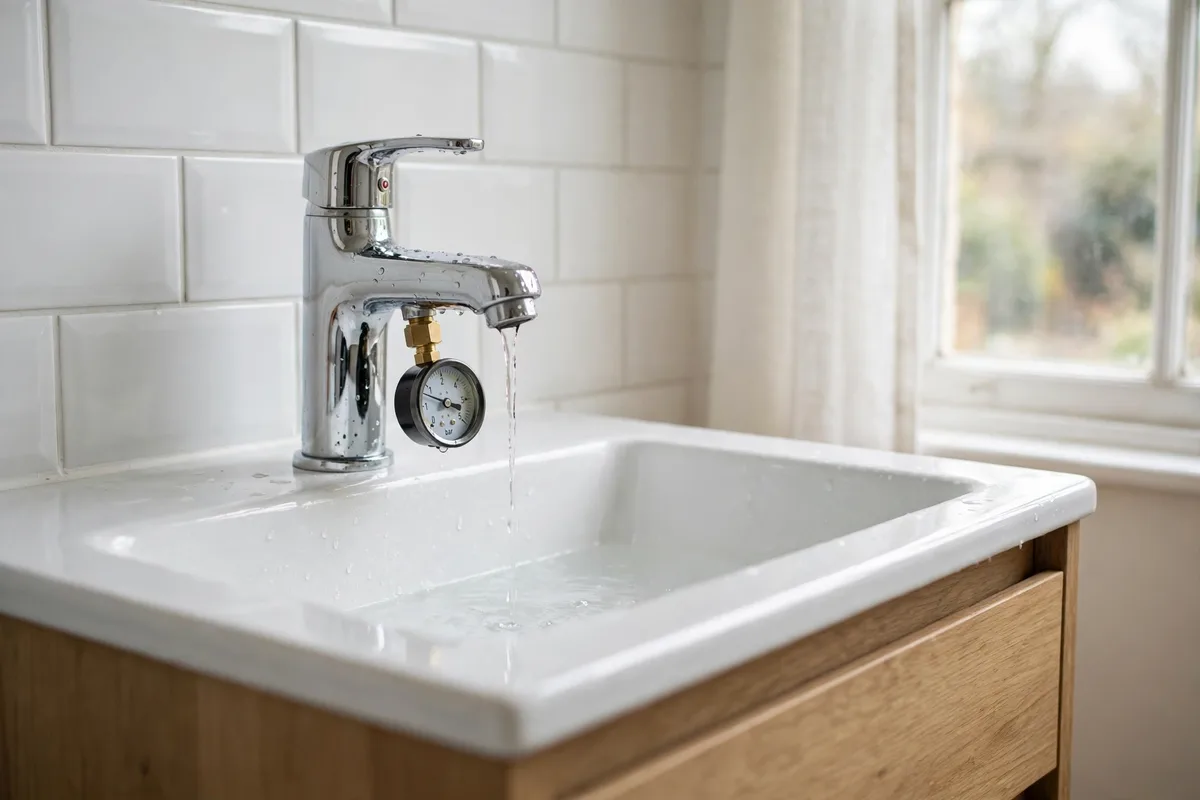
Use a pressure gauge. A screw-on water pressure gauge costs a few pounds from a plumbers’ merchant or DIY store. Screw it onto an outdoor tap, or onto the washing machine cold feed if you have no outside tap, turn the tap on fully, and read the dial. That reading is your static pressure, the pressure when no water is running. Then open another tap in the house and watch the gauge again. If the reading drops sharply, the flow is the problem, not just the pressure, and that points to a restriction somewhere in the pipework.
Know the numbers that matter. Typical UK mains pressure is 1 to 3 bar, and below 1 bar taps run slow and showers and appliances struggle (Platform Lift Hire). The statutory minimum your water supplier must provide is 1 bar at the boundary of your property (Platform Lift Hire). PlumbNation quotes the familiar 40 to 60 psi band, but for a UK reader bar is the useful figure, and psi is only a conversion: 1 bar is roughly 14.5 psi. If your gauge reads under 1 bar at the boundary tap, the problem may be the supplier’s mains, not your house, and that changes who you call.
Test one tap, then the whole house. A low reading at one tap only points inside the house, usually at that tap, its supply pipe, or a blocked aerator. Low pressure at every tap points at the supply or the system type. Check the hot and cold separately, too. If only the hot water is weak, the problem is in the hot water system, not the mains, and the pump or cylinder section of this guide is where the answer lies. If only the cold is weak on a gravity system, the cold tank feed is the suspect.
Check the flow as well as the pressure. Pressure and flow are not the same thing. Pressure is the force pushing the water; flow is how much water actually arrives. Fill a one-litre jug at the kitchen cold tap and time it. If it takes more than about six seconds, you are getting under 10 litres per minute, and a bath will take a very long time to fill. A house can have reasonable pressure but poor flow because of narrow or scaled-up pipes, and a pump will not fix a flow problem caused by a restriction it cannot push past.
Ask the neighbours. If the houses around you have the same weak pressure, the cause is almost certainly the local mains, and no amount of work inside your house will fix it. If yours is the only house affected, the fault is on your side of the boundary. That single check saves a lot of wasted effort, and it is the first thing a plumber will ask.
Check the Stopcock and Internal Valves
The most common cause of suddenly low pressure in a UK home is also the most embarrassing: a valve that is not fully open. Check every valve before you spend anything.
The main stopcock. The internal stopcock is usually under the kitchen sink, though in some houses it is under the stairs, in a downstairs cupboard, or near where the water main enters the house. Turn it fully anticlockwise until it stops, then back it off a quarter turn so it does not seize in the open position. A stopcock that was turned off for a repair and only opened halfway will throttle the whole house, and the pressure will be low at every tap. If the stopcock is stiff or seized, do not force it with a wrench. A seized stopcock that snaps leaves you with no way to turn the water off, which is a much bigger problem than low pressure.
The boundary stopcock. Outside your property, usually under a small cover in the pavement or front garden, is the water company’s stopcock. If work has recently been done on the street, or if a previous owner turned it down, it may be partly closed. You can check it, but do not force it, and if it needs attention, call your water company. They own everything up to the boundary, and they will check it free of charge.
Isolation valves under sinks and baths. Most modern taps and toilets have small isolation valves on their supply pipes, usually turned with a flat screwdriver or a small lever. If one tap is slow and the rest are fine, check the isolation valve feeding it. These valves are often turned down during a repair and forgotten. Turn it fully open and test the tap again.
Check for a partially closed gate valve on the system. Older houses sometimes have gate valves on the rising main or on the feed to a cold water tank. A gate valve that has been left half open after work on the system will restrict flow to the whole house. Unlike a stopcock, a gate valve can look open when it is not, so turn it fully anticlockwise and count the turns.
Do not ignore a recent change. If the pressure dropped suddenly, think about what changed. A new appliance, a repair, work on the street, or a new meter installation are all common triggers. Low pressure that arrived overnight almost always has a simple, recent cause, and it is usually a valve.
Limescale and Filters
In hard-water areas, which cover much of southern and eastern England, limescale is the slow thief of water pressure. It builds up over years, narrows pipes and blocks fittings, and the pressure falls so gradually that nobody notices until the shower becomes unusable.
Start with the aerators. Every modern tap has a small aerator screwed into the spout, a mesh disc that mixes air into the water. Unscrew it, and you will often find it clogged with white scale and grit. Soak it in white vinegar for an hour, scrub it with an old toothbrush, and screw it back. The difference is often dramatic, and it costs nothing. Do the same for every tap that runs slowly, and check the showerhead at the same time. A showerhead blocked with limescale will turn a good shower into a dribble, and soaking it in vinegar overnight usually restores it.
Clean or replace the showerhead. If the holes in a showerhead are visibly white and crusty, the head is the problem, not the pressure. Remove it, soak it in a bowl of white vinegar, and poke any stubborn holes clear with a pin. If the head is old and the scale is baked on, a replacement head is cheap and often improves the shower more than any pump would. This is also the moment to check whether the shower itself is the weak point. An electric shower has its own flow limits, and a mixer shower on a gravity system will always be weak if the tank is too low. The system section below explains why.
Check the filters and strainers. Combi boilers and many unvented systems have inlet filters and strainers that catch debris from the mains. Over time they clog, and the flow to the whole house falls. Your boiler’s manual will show where the filter is, but cleaning it is a job for a heating engineer if you are not confident, because it involves isolating the boiler and depressurising it. The same applies to the small filters in washing machine and dishwasher inlet hoses, which are easy to check yourself and often full of grit.
Old lead and galvanised pipes. Houses with original lead or galvanised steel supply pipes lose flow as the inside of the pipe furs up and corrodes. The pipe looks fine from the outside but is narrowed to a fraction of its original bore inside. If your house still has a lead supply pipe, the long-term fix is replacement with modern plastic or copper, and that is a job for a plumber and, for the section outside your boundary, your water company. No pump will fix a pipe that is choked inside.
Descale before you spend. Limescale is the cheapest cause to fix and the most common one in hard-water areas. Work through the aerators, the showerhead and the filters before you even think about a pump. If the pressure comes back, you have saved yourself hundreds of pounds.
PRV and Mains Facts: What Your Supplier Must Provide
Before you buy equipment, you need to know what you are entitled to and what is already fitted in your house. Two things matter here: the pressure-reducing valve, and the supplier’s legal minimum.
The pressure-reducing valve (PRV). Many homes, especially those in areas with high mains pressure or with unvented cylinders, have a PRV fitted on the incoming main. It is a brass valve, usually near the stopcock, that caps the pressure entering the house to protect the pipework and appliances. If it is set too low, or if it has failed and is stuck partly closed, the whole house will run at low pressure for no other reason. A PRV usually has an adjustment screw under a cap, and a plumber can test the pressure on either side of it and reset it in minutes. Do not adjust it yourself unless you know what you are doing: setting it too high can damage appliances and joints, and if you have an unvented cylinder the PRV is part of a safety system that should only be touched by a qualified engineer.
The supplier’s minimum: 1 bar. Your water company must supply at least 1 bar of pressure at the boundary of your property (Platform Lift Hire). If your gauge reads below 1 bar at the boundary tap, or if the flow is so low that a bath takes an unreasonable time to fill, call your water company and ask them to measure the mains pressure. They will check it, and if it is below the minimum they must investigate. Do not buy a pump to compensate for a supply that is below the legal minimum. The supplier has to fix their side first, and a pump fitted to a failing mains supply may not be legal anyway, as the next section explains.
Work out which system you have. The fix depends on the system, so identify yours before choosing anything. A mains-fed system takes water straight from the street main to every tap, and the pressure is whatever the mains provides. A gravity-fed system has a cold water tank in the loft feeding a hot water cylinder, and the pressure at any tap depends on the height of the tank above it: roughly 1 bar for every 10 metres of height (Tank Services). A combi boiler system is mains-fed for both hot and cold, and its pressure is the mains pressure minus whatever the boiler’s heat exchanger takes. The distinction matters because a gravity system can be improved by raising the tank or fitting a shower pump, while a mains-fed system has different options and different legal limits. A showerhead less than 1 metre below the tank water level will always underperform on a gravity system (PlumbNation), and no amount of cleaning will change that.
Low pressure at peak times. If the pressure is fine at night but poor at 7 in the morning, the mains in your street is struggling with demand, and the problem is shared. That is a supplier issue, not a household one, and it is worth reporting, because water companies log these complaints and use them to plan upgrades. A break tank and booster set, described below, is the only household fix that genuinely helps in this situation, and even then it is a significant job.
Pumps: Rules and Limits
This is the section where most guides go wrong, because they recommend a pump before explaining the law. In the UK, you cannot simply fit a pump to the mains and hope for the best.
The 12 litres per minute rule. UK water regulations prohibit pumping directly from the mains above 12 litres per minute. A pump that strong on the mains can reduce the pressure in the street main and breach the water bylaws (Tank Services; Platform Lift Hire). This is not a guideline. It is a legal limit, and it is enforced because a powerful pump in one house can leave the neighbours with no water at all. Any pump that draws more than 12 litres per minute from the mains must not be connected directly to it.
The compliant whole-house route: break tank plus booster. If you want a genuine whole-house pressure lift, the legal route is a break tank fed from the mains, with a booster pump on the tank outlet (Tank Services). The tank fills slowly from the mains at a rate the supply can handle, and the pump draws from the tank, not from the street. Tank Services suggests a 125 to 150 litre tank for a one to two bedroom flat and 200 to 250 litres for larger houses. This is a proper plumbing job, not a DIY purchase, and it needs space for the tank, a suitable pump, and an electrician for the wiring. It is the only route that gives a reliable whole-house fix on a weak mains supply.
Shower pumps and power showers. For a single weak shower, a shower pump or a power shower is the usual answer, and it is far cheaper and simpler than a whole-house system. City Plumbing names the Salamander CT50 Xtra and Stuart Turner Monsoon as typical shower pumps, and the Mira Vigour as a typical power shower. A shower pump boosts the hot and cold feed to one shower, and it is the standard fix for a gravity-fed system where the loft tank is too low to give a decent shower. A power shower is a combined shower and pump unit. Both need a qualified plumber to fit, and both need the pipework to be suitable, but they solve the most common complaint in the house without touching the mains.
Inline mains boosters within the limit. An inline mains booster, such as the Salamander HomeBoost named by City Plumbing, works within the 12 litres per minute limit to lift the pressure of the whole house. It is a smaller job than a break tank and booster set, and it is the right choice where the mains pressure is only slightly below what you need. It will not turn a very weak supply into a strong one, and it will not help if the real problem is a blocked pipe or a low tank. Ask the supplier or a plumber to confirm the unit is compliant with the water regulations before it is fitted.
Unvented cylinders for larger homes. For a larger multi-bathroom home, an unvented cylinder, such as a Megaflo named by City Plumbing, replaces the gravity system with a mains-pressure hot water store. It gives strong pressure at every hot tap and shower, but it is a major installation, it needs a suitable mains supply to work properly, and it must be fitted by an engineer qualified to work on unvented systems. It is the right answer for a big house with several bathrooms, and overkill for a small flat with one weak shower.
What pumps cost. None of the top guides checked for this article gives a sourced UK cost for a booster pump, a break tank and booster set, or an unvented cylinder upgrade, so no price is given here. The cost depends on the unit, the pipework, the electrics and the region, and any figure quoted without a source would be invented. Get written quotes from two or three local plumbers, and make sure each quote says whether it includes the pump, the tank, the wiring and any building control notification. A quote that only covers the pump is not the whole job.
Pumps are for a qualified plumber. Fitting a pump involves water regulations compliance, electrical work, and, for unvented systems, a qualification that not every plumber holds. A badly fitted pump can damage your pipework, breach the water regulations, and leave you liable if it affects the neighbours’ supply. This is not a job to buy online and fit on a Saturday.
When It Is a Leak, Not Pressure
Sometimes the pressure is not low because the supply is weak. It is low because water is escaping somewhere before it reaches your taps, and the fix is finding the leak, not boosting the pressure.
The signs of a hidden leak. A water meter that turns when every tap is off, a patch of ground outside that is always damp, a musty smell under the floor, plaster that is soft or stained, or a water bill that has jumped without explanation are all signs of a leak on your side of the boundary. A leak between the boundary and your house steals pressure from every tap, and it will get worse, not better, if you fit a pump, because the pump will push more water out of the leak.
Check the meter. If you have a water meter, turn off every tap and appliance in the house, then watch the meter for fifteen minutes. If it moves, water is going somewhere it should not be. That is the test your water company will ask you to do before they send anyone out, so do it first and note the result.
Look inside the house too. A dripping tap wastes water, but it does not usually drop the pressure of the whole house. A leaking toilet cistern, a split pipe under the floor, or a joint that has failed behind a wall can. Our guide to how to fix a dripping tap covers the tap side of water waste, and our guide to how to unblock a toilet explains how a toilet’s internal workings can waste water without anyone noticing. If the leak is inside the house, the damp it causes is a problem in its own right, and our guide to the types of damp in a house explains how to tell a leak apart from condensation and rising damp, so you can be sure what you are dealing with before you call anyone.
Who pays for what. Your water company owns the pipe up to the boundary of your property, and you own the pipe from the boundary into the house. If the leak is on their side, they fix it. If it is on yours, you do, and your buildings insurance may cover the repair and the damage it caused, so check the policy before you pay for anything yourself. If you are unsure where the boundary is, ask the water company. They can tell you, and they can usually locate the leak with acoustic equipment if you cannot find it.
Do not fit a pump to mask a leak. A pump will hide the symptom and make the leak worse. It will push more water through the split pipe, increase the damage to floors and walls, and waste more water. Find the leak first, fix it, and then test the pressure again. In many houses, fixing the leak restores the pressure completely, and no pump is needed at all.
Frequently Asked Questions
What is normal water pressure in a UK house?
Typical UK mains pressure is 1 to 3 bar, and below 1 bar taps run slow and showers and appliances struggle (Platform Lift Hire). The statutory minimum your water supplier must provide is 1 bar at the boundary of your property. If your gauge reads under 1 bar at the boundary tap, ask your water company to measure the mains pressure before you spend anything inside the house.
How do I test my water pressure at home?
Screw a pressure gauge onto an outdoor tap or the washing machine cold feed, turn the tap on fully, and read the dial. That is your static pressure. Open another tap and watch the gauge again to see how the pressure holds under flow. Also time how long it takes to fill a one-litre jug at the kitchen cold tap: more than about six seconds means under 10 litres per minute, which is poor flow.
Why is my water pressure low in only one tap?
A single slow tap usually means a problem at that tap: a partially closed isolation valve, a clogged aerator, or limescale in the tap or showerhead. Check the isolation valve under the sink or bath, unscrew the aerator and soak it in white vinegar, and clean the showerhead. If every tap is slow, the cause is at the stopcock, the PRV, or the mains supply.
Can I fit a pump directly to the mains?
No, not above 12 litres per minute. UK water regulations prohibit pumping directly from the mains above that rate, because it can reduce the pressure in the street main and breach the water bylaws (Tank Services; Platform Lift Hire). The compliant whole-house route is a break tank fed from the mains with a booster pump on the tank outlet. A shower pump for a single shower, or an inline booster that works within the 12 litres per minute limit, are the smaller alternatives.
Will a pump fix low pressure on a gravity-fed system?
Yes, for the shower at least. A shower pump is the standard fix for a gravity system where the loft tank is too low to give a decent shower. A showerhead less than 1 metre below the tank water level will always underperform (PlumbNation), and a pump is the practical answer. For the whole house on a gravity system, a break tank and booster set or an unvented cylinder are the options, and both are jobs for a qualified plumber.
How much does it cost to increase water pressure in the UK?
No sourced UK price consensus exists in the guides checked for this article, so no figure is given here. Costs depend on the unit, the pipework, the electrics and the region. Get written quotes from two or three local plumbers, and make sure each quote covers the pump, the tank if one is needed, the wiring, and any building control notification. Do not accept a quote that only covers the pump.
Should I call my water company or a plumber first?
Call the water company first if the pressure is low at every tap, if the neighbours have the same problem, or if your gauge reads under 1 bar at the boundary. They own the supply up to your boundary and will measure the mains pressure. Call a plumber if the pressure is low at one tap only, if the problem is in the hot water system, or if you need a pump, a break tank, or an unvented cylinder fitted.
Sources for pressure, system and regulation figures in this article: Tank Services, how to increase or boost water pressure; City Plumbing, shower pump replacement; PlumbNation, the complete guide to water pressure; FS Group, increase water pressure in house; Platform Lift Hire, how to boost water pressure in your house UK. Search volume and KGR: not verified.