
How to Fix a Sticking UPVC Door: A UK Homeowner’s Guide
A UPVC door that suddenly sticks, drags on the frame, or refuses to lock properly is one of the most common maintenance issues UK homeowners face, and it is especially common when the seasons change. The frustrating part is that a sticking door often has nothing to do with the door itself failing, and everything to do with a simple adjustment that takes a few minutes with the right screwdriver.
This guide explains why UPVC doors stick, how to diagnose the exact cause, and the step-by-step fixes for the most common problems.
Why UPVC Doors Stick, and Why It Is Worse in Summer
In short: UPVC expands slightly in hot weather and contracts in the cold, which shifts the fit of the door within its frame just enough to cause dragging, sticking or locking problems, particularly on doors that were already sitting close to the edge of correct alignment.
Beyond temperature, the other common causes are hinges that have dropped slightly from the weight of the door over time, a multi-point locking mechanism that has fallen out of alignment, or door furniture that has simply loosened through daily use.
How to Diagnose the Problem
| Symptom | Likely Cause |
|---|---|
| Door drags along the bottom of the frame | Hinges have dropped, door needs vertical adjustment |
| Door is hard to close, feels tight on one side | Lateral hinge misalignment or seasonal expansion |
| Key turns but the door will not lock fully | Multi-point lock or keep plates out of alignment |
| Handle feels loose or does not lift properly | Worn or loose handle mechanism |
| Door only sticks in hot weather | Normal seasonal UPVC expansion, usually needs minor adjustment |
Tools You Will Need
- Allen key or hex key set (most UPVC hinges use 4mm or 5mm)
- Flat and cross-head screwdrivers
- Silicone-based lubricant spray
- A pencil, for marking the door’s resting position before you start
Step-by-Step: Adjusting UPVC Door Hinges
Most modern UPVC doors use adjustable hinges, usually with small hex screws hidden behind a cover cap or accessible directly on the hinge itself. These allow adjustment in three directions.
Lateral (Side-to-Side) Adjustment
This moves the door closer to or further from the frame seal. Turning the top hinge screw clockwise typically pulls the door in slightly, which helps if the door feels loose or draughty, while turning anticlockwise moves it out, which helps if the door is sticking or difficult to close.
Vertical (Height) Adjustment
If the door drags along the bottom of the frame, the hinges have likely dropped slightly. Most hinges have a vertical adjustment screw, usually on the hinge itself, that lifts the door back into the correct height. Adjust in small increments, testing the door after each turn.
Compression Adjustment
Some hinges also allow you to adjust how tightly the door compresses against the seal when closed. Increasing compression can help with draughts, but overtightening can itself cause a door to feel stiff, so make small adjustments and test as you go.
Fixing the Multi-Point Locking Mechanism
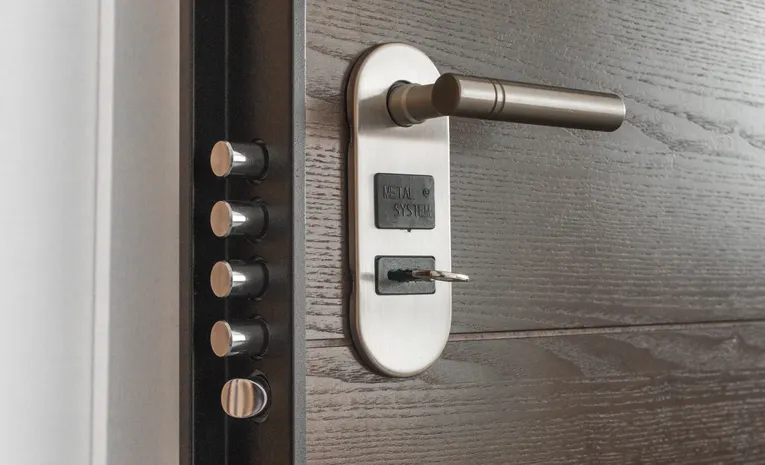
If the key turns but the door will not lock, or locks only with excessive force, the multi-point locking points along the edge of the door are likely misaligned with their keeps in the frame. Open the door and check each locking point lines up cleanly with its corresponding keep. Small adjustments to the hinges, as above, often resolve this, since the whole door needs to sit correctly for every lock point to engage.
Realigning the Keep or Strike Plates
If one specific lock point consistently fails to engage while the others work fine, the keep plate on the frame itself may need repositioning. Loosen the fixing screws slightly, adjust the plate’s position by a millimetre or two, retighten, and test the lock again.
Seasonal Maintenance: Preventing Sticking Before It Happens
- Lubricate hinges, locks and moving parts with a silicone-based spray twice a year, ideally at the start of spring and autumn.
- Clean the door seals regularly to stop dirt build-up affecting the compression fit.
- Check and gently tighten hinge and handle screws every few months, since daily use naturally loosens them over time.
- Avoid slamming the door, which accelerates wear on both hinges and the locking mechanism.
DIY vs Calling a Professional: Cost Comparison
| Job | DIY Cost | Professional Cost (UK average) |
|---|---|---|
| Hinge adjustment | Free (tools you likely already own) | £40 to £70 call-out |
| Replacing worn hinges | £15 to £40 per hinge | £60 to £120 |
| Multi-point lock replacement | £30 to £80 | £100 to £200 |
| Full door realignment service | Not applicable | £60 to £100 |
Frequently Asked Questions
Why does my UPVC door only stick in hot weather?
UPVC expands slightly as temperatures rise, which can be enough to make a door that was already sitting close to its frame start to drag or stick. A small hinge adjustment usually resolves this permanently.
Can you adjust UPVC door hinges yourself?
Yes. Most UPVC doors use adjustable hinges designed for exactly this kind of fine-tuning, accessible with a standard Allen key. No specialist tools or trade knowledge are required for a basic adjustment.
How often should UPVC doors be serviced?
A light service, lubricating hinges and locks and checking screws are tight, is worth doing roughly twice a year. This keeps the mechanism working smoothly and catches minor misalignment before it becomes a bigger problem.
My UPVC door won’t lock at all. What should I check first?
Check whether the door is sitting flush in the frame when closed. If it is not closing fully square, the multi-point lock points will not align with their keeps, which is the most common reason a door will not lock even though the key turns.
Related Reading
- How to Draught-Proof Your Home for Winter
- Why You Should Hire a Qualified Plumber
- Best Home Security Systems for UK Homes
About the author: This guide was written by the Routen House editorial team, based on standard UK trade practice for UPVC door adjustment and maintenance.