
How to Clean a Washing Machine: A UK Homeowner’s Guide
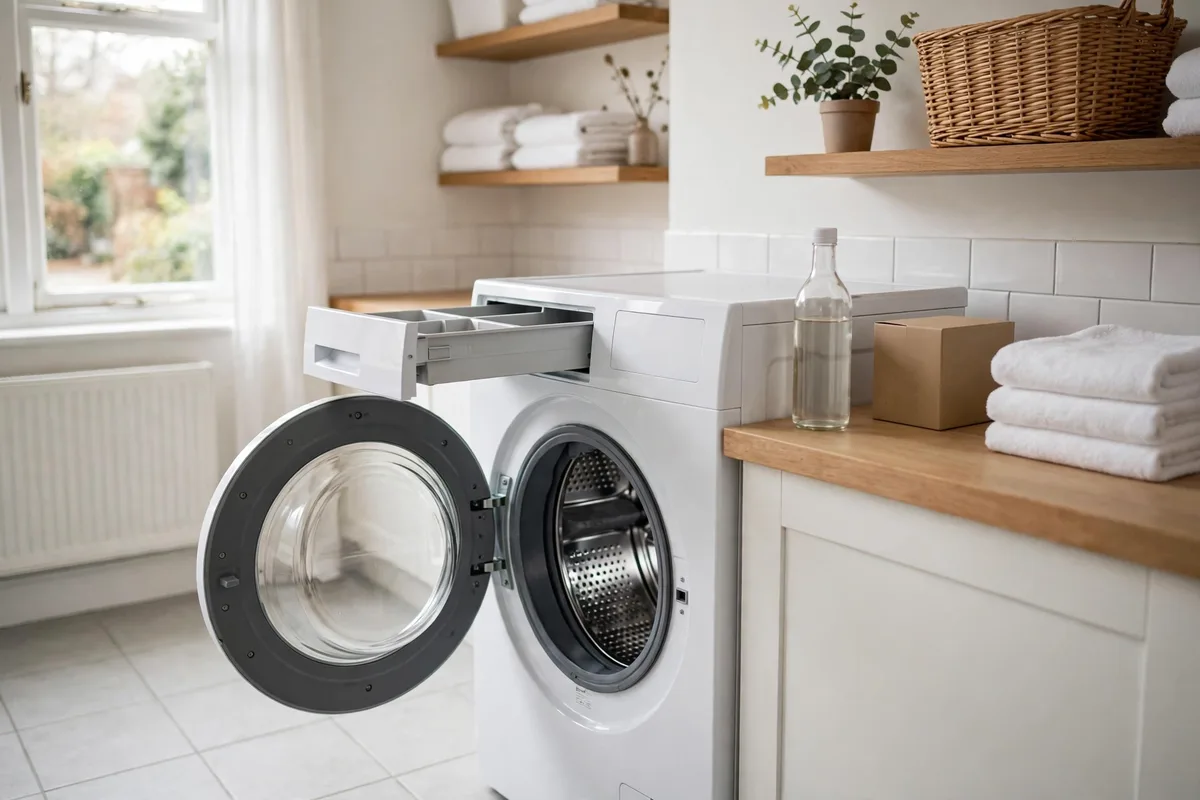
Your washing machine is supposed to make things clean. So when the laundry comes out smelling damp, or the drum has a grey film, or black spots appear around the rubber seal, something has gone wrong inside the machine itself. Around 97 per cent of UK households own a washing machine, and most of them are never cleaned. That matters, because a dirty machine does not just smell. Detergent scum, limescale and trapped moisture build up inside the drum, the drawer and the drain, and the result is laundry that is never properly clean, a machine that works harder than it should, and in the worst cases a repair bill. Washing machine repairs rose 24 per cent between 2020 and 2022, and regular cleaning is one of the simplest ways to stay on the right side of that trend.
The good news is that cleaning a washing machine needs no special tools and no expensive products. White vinegar, bicarbonate of soda, an old toothbrush and a cloth will do most of the work, and a shop-bought washing machine cleaner costs a few pounds in any UK supermarket if you would rather use one. What matters is doing the whole routine, in the right order, and then keeping up the small habits that stop the dirt coming back. This guide gives you that routine, a smell diagnosis ladder for when something already smells wrong, descaling advice for hard-water areas, and the habits that keep a machine fresh between deep cleans.
Before you start, check your machine’s manual. Different models have different filter positions, drawer release buttons and temperature limits, and a few manufacturers warn against specific cleaners. If you cannot find the manual, the model number on the inside of the door or on the back of the machine will find it online. Turn the machine off at the socket before you touch the filter, and never mix bleach with any other cleaner.
The Full Routine: Drum, Drawer, Gasket and Filter
Do the routine in this order. Each step clears the way for the next one, and the hot maintenance wash at the end flushes out everything you have loosened.
Step 1: the detergent drawer. Pull the drawer out. Most UK machines have a small release tab or button in the middle of the drawer; press it and the drawer slides right out. Soak it in warm water with a squirt of washing-up liquid for ten minutes, then scrub it with an old toothbrush. Pay attention to the corners and the underside, where black mould and congealed fabric conditioner collect. While the drawer soaks, wipe inside the empty drawer housing with a damp cloth, reaching as far back as you can. Dry the drawer fully before you slide it back in. A wet drawer is where the mould starts again.
Step 2: the rubber door seal, or gasket. This is the part most people skip, and it is usually the source of the smell. Pull the seal back gently with your fingers and look inside the folds. You will often find grey slime, black mould spots, hair, coins and the odd sock. Wipe the whole seal with a cloth dampened with white vinegar, working right into the folds. For stubborn black spots, leave a vinegar-soaked cloth pressed against the mould for an hour, then scrub with the toothbrush and wipe clean. Do not use neat bleach on the seal unless your manual allows it, and do not use vinegar every week. Vinegar is acidic, and used too often it can perish rubber seals over time. Once a month as part of a deep clean is fine.
Step 3: the drum. With the drawer and seal clean, run the drum clean. Pour two cups of white vinegar into the detergent drawer and half a cup of bicarbonate of soda directly into the empty drum, then run an empty cycle on the hottest setting your machine has, ideally 90°C. The heat is what does the real work. It dissolves detergent residue, kills the bacteria and mould that cause smells, and flushes the internal pipes. If you would rather use a shop-bought cleaner, follow the packet instructions instead and run the same empty hot wash. Dr Beckmann, Dettol and Dylon all make washing machine cleaners sold in UK supermarkets, and they work the same way: powder or liquid in the empty drum, hot cycle, done. Do not put laundry in during a cleaning cycle. The vinegar, the heat and the cleaner are all too strong for clothes.
Step 4: the drain pump filter. This is the step most guides skip, and it is the one that fixes the slow drains and standing water that people blame on the machine itself. The filter sits behind a small flap at the bottom front of the machine. Put a shallow tray and an old towel on the floor in front of it first, because water will come out. Unscrew the filter slowly, anticlockwise, and let the water drain into the tray. Pull the filter out and clean off the lint, hair, coins, buttons and grit trapped in it. Rinse it under the tap, wipe the filter housing with a cloth, then screw it back in firmly. If the filter will not turn, do not force it with pliers. Try turning it a quarter turn back and forth to work it free, and if it still will not move, leave it for an engineer. A forced filter can crack the housing and cause a leak. Check the filter every two to three months, or every month if you wash a lot of pet bedding or work clothes.
Step 5: the outside and the door. Wipe the outside of the machine, the control panel and the door glass with a damp cloth. Leave the door open for a few hours after the cleaning cycle so the drum and the seal dry out fully. This one habit does more to stop smells returning than anything else in this guide.
Front-loader or top-loader? The routine above is written for front-loaders, which are the most common machines in UK homes. If you have a top-loader, the steps are the same but the details change: pour the vinegar directly into the drum rather than the drawer, wipe the inside of the lid and the top rim where water collects, and clean the fabric conditioner dispenser in the centre agitator if your model has one. Top-loaders rarely have a rubber door seal, so the gasket step does not apply, but the filter step still does.
The Smell Diagnosis Ladder
A smell is a symptom, and different smells point to different causes. Work down this ladder from the top. Fix the first cause that matches, run a hot empty cycle, and only move down if the smell is still there.
Musty or damp smell. This is the most common one, and it almost always means mould in the door seal or in the detergent drawer. Clean both as described above, then leave the door open after every wash for a week. If the smell comes from the drawer housing, the mould may be further back than you can reach. A second hot cycle with vinegar usually clears it.
Sewage or drain smell. This usually means the drain pump filter is blocked, or the drain hose has a problem. Clean the filter first. If the smell is still there, check that the drain hose loops up to the correct height before it joins the waste pipe. A hose that drops straight down can let drain smells travel back into the machine. If the hose looks right and the filter is clean, the problem may be in the household drain rather than the machine, and that is a drainage job, not a cleaning job.
Rotten egg smell. This points to bacteria building up in standing water, often in the filter housing or in the drain hose. Clean the filter, then run two hot empty cycles back to back with a shop-bought cleaner. If the smell survives that, the drain hose may need replacing, which is a job for an engineer.
Burning smell. Stop. Do not run another cycle. A burning smell can mean a worn drive belt, a failing motor or an electrical fault. Switch the machine off at the socket and call an engineer. Cleaning will not fix it, and running the machine could make it worse.
Smell only on one type of wash. If clothes smell fine after a hot wash but not after a 30°C wash, the problem is temperature, not dirt. Most daily washes at 30 to 40°C are not hot enough to dissolve detergent residue or kill bacteria and mould. The fix is a monthly maintenance wash at 60°C or higher, and cutting back on detergent. Using more detergent than the packet recommends does not make clothes cleaner. The extra detergent does not rinse out fully, it coats the drum and the pipes, and that coating is what the bacteria feed on.
If you have worked down the whole ladder and the smell is still there, the fault is probably inside the machine, in the sump hose or the outer drum, where you cannot reach it without taking the machine apart. That is the point to call an engineer rather than clean harder. A related warning sign is water waste: if your toilet is also running constantly, the water and money wasted add up fast, so it is worth reading our guide to how to fix a running toilet as well.
Descaling in Hard-Water Areas
Limescale is the quiet problem. You cannot smell it, and you cannot see it until it is bad, but in hard-water areas it coats the heating element, the drum and the pipes, makes the machine work harder, and shortens its life. Much of the south east, London, East Anglia and parts of the Midlands have hard or very hard water. If your kettle furs up quickly, your washing machine is getting the same treatment.
Descale every one to three months in a hard-water area, and every three to six months in a soft-water area. The method is the same as the drum clean: two cups of white vinegar in the drawer, half a cup of bicarbonate of soda in the drum, empty hot cycle at 90°C. The vinegar dissolves the limescale while the heat carries it away. Citric acid works the same way and is worth using if you dislike the vinegar smell. Use about 100 grams in the drum on an empty hot cycle. Shop-bought descalers are also fine, and some are made specifically for hard-water areas, so follow the packet dose rather than guessing.
Three things make descaling work better. First, use less detergent in hard-water areas, not more. Hard water already stops detergent working properly, and adding more only leaves more residue behind. Second, run a monthly maintenance wash at 60°C or higher even if the machine does not smell. Third, check the inlet filter where the water hose meets the machine. It is a small mesh screen, and in hard-water areas it can clog with limescale and grit, which slows the fill and strains the inlet valve. Turn off the water at the tap, unscrew the hose, rinse the mesh under the tap, and put it back.
If your machine has a descaling or drum-clean programme, use it. It runs longer and hotter than a normal cycle and is designed for exactly this job. If it does not, the manual hot cycle described above does the same thing.
Habits That Keep It Clean
A deep clean every one to three months is the foundation, but the daily habits are what keep the machine fresh between deep cleans. They take seconds, and they stop the problems before they start.
Leave the door open after every wash. This is the single most effective habit. A closed door traps warm, moist air inside the drum, which is exactly the environment mould and mildew need. Leave the door ajar, and leave the detergent drawer pulled out a centimetre as well, so air can circulate through the whole machine.
Use the right amount of detergent. Follow the dose on the packet for your water hardness and load size, and do not add extra for a heavily soiled load. A second rinse is better than extra detergent. Too much detergent leaves residue in the drum, the drawer and the pipes, and that residue is the food source for the smells you are trying to avoid.
Run a hot wash regularly. Run at least one cycle at 60°C or higher every month, even if it is just towels or bedding. Most daily washes at 30 to 40°C are not hot enough to dissolve detergent residue or kill bacteria and mould. A monthly hot wash flushes the system and keeps the residue from building up.
Take laundry out promptly. Wet laundry left in the drum for hours goes musty, and that mustiness transfers to the drum and the seal. If you cannot empty the machine straight away, use the delay start so the cycle finishes when you are home.
Wipe the seal and drawer weekly. A quick wipe with a dry cloth after your last wash of the week takes thirty seconds and stops moisture sitting in the folds of the seal. It is the same logic as drying a shower screen: the mould never gets a chance to start.
Clean the filter on schedule. Put it in your calendar every two to three months, the same as you would a boiler service. A clean filter drains faster, smells better and puts less strain on the pump. While you are thinking about the rest of the laundry area, our guide to what a heat pump tumble dryer is explains the other appliance that shares the space, and if you want the same approach for the bathroom, our toilet cleaning tips cover that room in the same step-by-step style.
A clean washing machine is not a luxury. It is the difference between laundry that smells fresh and laundry that smells damp the moment it comes out of the drum. Do the full routine once, then keep up the habits, and the machine will do its job properly for years longer.
Frequently Asked Questions
How often should I clean my washing machine?
Do a deep clean every one to three months, depending on how often you use the machine and how hard your water is. Run a maintenance wash, an empty hot cycle at 60°C or higher, once a month. Clean the drain pump filter every two to three months. If you wash a lot of pet bedding, work clothes or cloth nappies, clean more often.
Can I use white vinegar to clean my washing machine?
Yes. Pour two cups of white vinegar into the detergent drawer and half a cup of bicarbonate of soda into the drum, then run an empty cycle at 90°C. Vinegar dissolves limescale and soap scum and kills odour-causing bacteria. Do not use vinegar every week, because the acid can perish rubber seals over time. Once a month as part of a deep clean is fine. Never mix vinegar with bleach.
Why does my washing machine smell even after a wash?
The smell is usually mould in the rubber door seal, a clogged drain pump filter, or detergent residue in the drum. Work down the smell diagnosis ladder in this guide: clean the seal and drawer first, then the filter, then run a hot empty cycle. If the smell survives all three, the fault may be inside the machine and needs an engineer.
Can I use bleach in my washing machine?
You can, but with care. Bleach is only suitable for cold or warm cycles, around 40°C, and it can damage certain washing machine components. Always check your machine’s manual before using bleach, and never mix it with vinegar or any other cleaner. For most people, vinegar and bicarbonate of soda or a shop-bought washing machine cleaner is safer and just as effective.
How do I clean the black mould on the rubber seal?
Pull the seal back gently and wipe inside the folds with a cloth dampened with white vinegar. For stubborn black spots, press a vinegar-soaked cloth against the mould for an hour, then scrub with an old toothbrush and wipe clean. If the mould has eaten into the rubber and will not come off, the seal itself may need replacing, which is an engineer job.
How do I clean the detergent drawer?
Pull it out using the release tab, soak it in warm water with washing-up liquid for ten minutes, then scrub it with an old toothbrush, paying attention to the corners and the underside where black mould collects. Wipe inside the empty drawer housing, dry the drawer fully, then slide it back in.
What is the black stuff in my detergent drawer?
It is mould, fed by trapped moisture and leftover detergent and fabric conditioner. It is common in drawers that are never removed or dried. Clean it as described above, and leave the drawer pulled out slightly after each wash so it dries.
My washing machine still smells after cleaning. What now?
If you have cleaned the seal, the drawer, the drum and the filter, and run two hot empty cycles, the fault is probably inside the machine, in the sump hose or the outer drum, where you cannot reach it without taking the machine apart. Stop cleaning and call an engineer. A burning smell at any point means switch the machine off at the socket and call an engineer straight away.