
How to Fix a Running Toilet: A UK Homeowner’s Guide
How to Fix a Running Toilet: A UK Homeowner’s Guide
A running toilet is easy to ignore because it still flushes. The cistern refills, the toilet works, and the only sign that anything is wrong is a faint hiss, a trickle you can hear at night, or a cistern that tops itself up every few minutes for no reason. Ignore it for long enough, though, and it stops being a minor annoyance. A toilet that runs constantly can waste hundreds of litres of clean water a day, and on a metered supply that waste shows up directly on your bill.
The good news is that most running toilets have one of three causes, all of them inside the cistern, and most of them are fixable without a plumber. The skill is not in the fix itself, which is usually a small adjustment or a replacement seal. The skill is in working out which part is at fault before you buy anything, because the three causes look identical from outside the cistern and need different fixes. This guide follows the job in the order a plumber would do it: why a toilet runs, how to identify your mechanism, the fix for each mechanism, a simple leak test to confirm the diagnosis, what the waste actually costs, and when the whole cistern needs a professional.
Why a Toilet Runs: Inlet Valve, Flush Valve or Syphon
A toilet cistern has two jobs, and two valves to do them. The inlet valve, also called the fill valve, lets mains water into the cistern after a flush and shuts it off when the cistern is full. The flush valve, in a modern push-button toilet, holds the water in the cistern until you press the button, then lifts a seal to let the water out into the bowl. In an older lever-flush toilet, the same holding job is done by a syphon, a bent tube that only moves water when the lever lifts it over its internal hump. A running toilet means one of these parts is failing to close, or failing to shut off, and water is escaping from the cistern into the bowl or down the overflow, so the inlet valve keeps topping it up.
There are three common faults, and each sounds slightly different. First, the water level is set too high, or the inlet valve is not shutting off. In this case the water rises above the top of the overflow pipe, or above the internal overflow level of a modern flush valve, and spills constantly into the bowl. You will hear a steady hiss or a continuous trickle, and the water level in the cistern will sit at or above the overflow. Second, the flush valve seal is worn, dirty or warped. Here the water level stays below the overflow, but water leaks slowly past the seal into the bowl. The cistern level drops a little, the inlet valve tops it up, and the cycle repeats every few minutes, which is why this fault is often called phantom flushing. Third, on a traditional syphon toilet, the syphon itself is the problem. A syphon toilet has no flush valve seal in the modern sense. If water is trickling constantly into the pan on a syphon toilet, it usually means the inlet valve has failed to shut off and water is spilling down the syphon’s internal overflow, rather than the syphon leaking on its own.
A fourth cause is worth ruling out before you touch anything: debris under a seal. Limescale, grit and sediment from the mains supply can wedge under the flush valve seal or inside the inlet valve, holding it slightly open. This is common in hard-water areas, and it is the cause most often fixed for free, by cleaning rather than replacing. A seal that looks worn may only be dirty, so clean first and replace second.
Knowing which of the three faults you have matters because the parts are different, the fixes are different, and buying the wrong part is the most common way a simple job turns into two trips to the trade counter. The next section shows you how to tell them apart in about two minutes, with the lid off.
Open the Cistern and Identify Your Mechanism
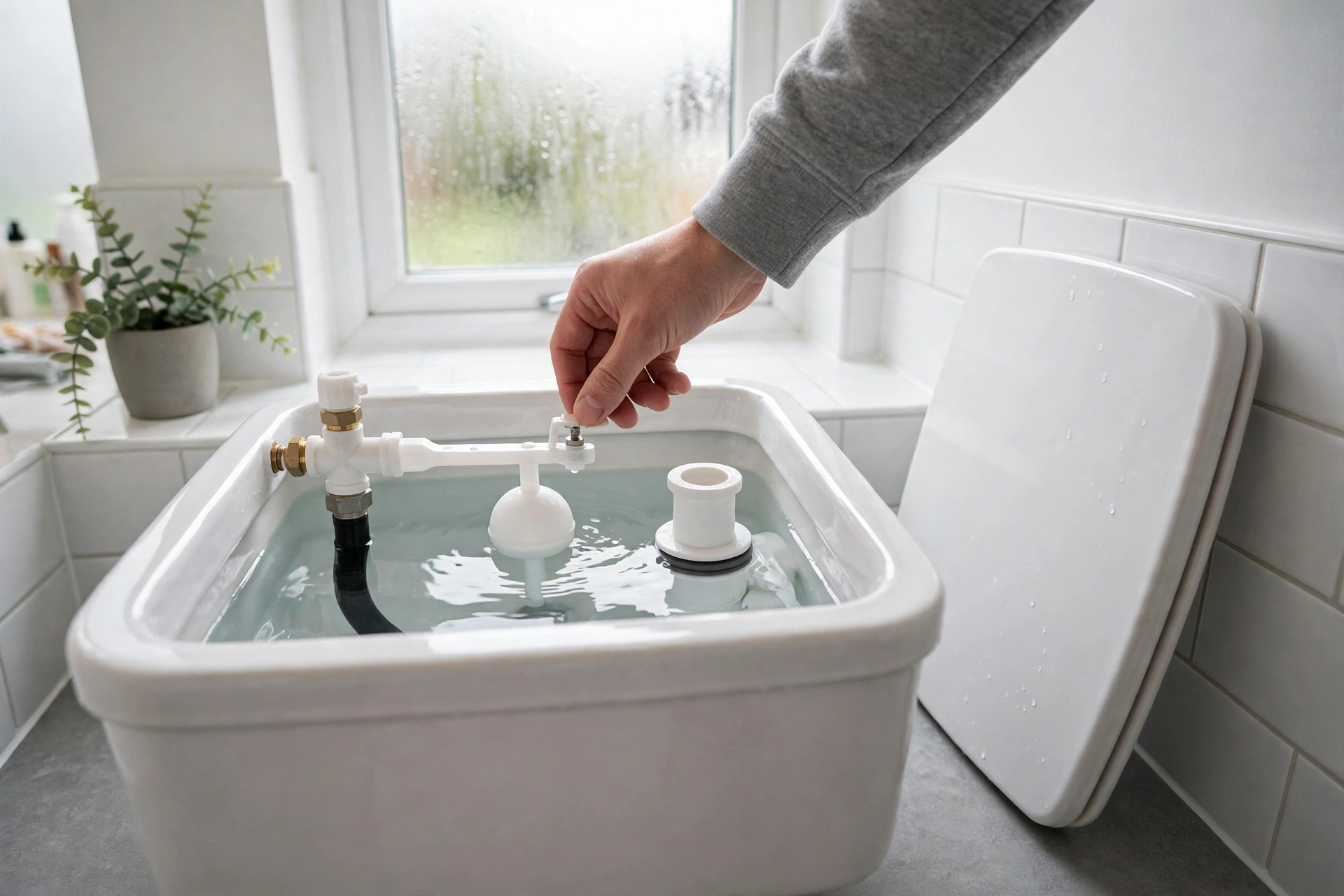
Start by lifting the cistern lid. On a close-coupled toilet, the lid usually lifts straight off, though on a push-button toilet you may need to unscrew the button surround first, by hand, turning it anticlockwise. Set the lid somewhere safe, on a towel on the floor, because a ceramic lid dropped on a tiled floor breaks easily and is expensive to replace. The water inside the cistern is clean mains water, so there is nothing unpleasant about reaching in, but wash your hands afterwards as a matter of course.
Before you touch any part, flush the toilet and watch what happens. Watch the water level as the cistern refills. Does it stop cleanly below the overflow, or does it keep rising until water spills into the overflow pipe or down the internal overflow of the flush valve? Does it stop, sit quietly for a few minutes, and then start refilling on its own? Does water trickle into the bowl even when the cistern is full and quiet? Each answer points to a different fault. If the water rises into the overflow, the inlet valve is the suspect. If the level stays below the overflow but the bowl trickles and the cistern refills by itself, the flush valve seal is the suspect. If you have a lever handle and a syphon, and water runs constantly, the inlet valve is again the prime suspect, because a syphon cannot leak in the way a valve seal can.
Now identify the parts in front of you. The inlet valve is the tall valve on the side where the water supply pipe enters the cistern, usually on the left as you face the toilet, with a float attached to it. On a modern toilet the float is a cup that slides up and down a rod or the valve body itself. On an older toilet the float is a ball on the end of a long arm. The float rises with the water and shuts the valve off when the water reaches the set level. The flush valve, in a push-button toilet, is the larger unit in the centre of the cistern, with the push-button rods or cables running down to it and a rubber seal at its base, where it meets the hole into the bowl. The syphon, in a lever toilet, is a tall, usually white or grey plastic unit in the centre, with a lever arm connected to the handle and a curved tube inside it. If you are not sure which you have, the handle tells you: a button on the lid means a flush valve, a lever on the side or front of the cistern means a syphon.
Find the isolation valve before you need it. This is the small valve on the pipe feeding the cistern, usually on the wall or floor behind or beside the toilet, often with a slot for a flat-head screwdriver. Turning the slot a quarter turn, so it sits across the pipe, shuts the water off to the cistern. Test it now, while nothing is urgent. If it is seized, a squirt of penetrating oil and gentle movement may free it, but do not force it so hard that it snaps. If there is no isolation valve, you can stop the water temporarily by lifting the float by hand and holding it up with string tied to the overflow pipe, which keeps the inlet valve closed while you get parts. Note also whether your cistern is concealed, boxed in behind a panel or inside furniture. A concealed cistern uses the same parts, but access is through a front panel, and if the panel is tiled in or sealed, removing it without damage may be a job for a professional rather than a first DIY attempt.
With the mechanism identified and the water level observed, you have a diagnosis. The next section gives the fix for each mechanism, in the order to try them.
Fix by Mechanism
Work through the fixes in this order: adjust first, clean second, replace third. Most running toilets are fixed at step one or two, with no parts at all, and jumping straight to replacement wastes money and risks fitting the wrong part.
If the water level is too high, adjust the inlet valve. On a modern float-cup valve, there is usually a small adjustment screw on top of the valve body, or a clip on the float. Turning the screw clockwise lowers the float and therefore lowers the water level. On a ball-float valve, bend the arm gently downwards, or turn the adjustment screw where the arm meets the valve, so the ball sits lower in the water. Aim for the water to stop about 25 millimetres, roughly an inch, below the top of the overflow pipe or the internal overflow level. Flush, let the cistern refill, and watch. The valve should shut off cleanly before the water reaches the overflow, with no hiss and no trickle. If the level is right but the valve still hisses and never fully shuts off, the valve itself is worn or clogged, and cleaning or replacement is next.
If the flush valve seal is leaking, clean it before you replace it. On a push-button toilet, the flush valve usually twists or unclips from its base. Lift or twist it out, following the maker’s instructions for your model, and look at the rubber seal on its base. Wipe the seal and the seating surface it presses against with a damp cloth, removing limescale, grit and any slime. Refit it, flush, and watch for a few minutes. If the trickle into the bowl has stopped and the cistern no longer refills on its own, the job is done. If the seal is cracked, hardened, warped or perished, cleaning will not save it. Replacement seals are sold for most common makes, including Siamp and Fluidmaster, and fitting one is usually a matter of pulling the old seal off and pressing the new one on. Take the old seal with you to the trade counter or photograph it with its measurements, because seals look similar but are not interchangeable. If no replacement seal is available for your valve, replace the whole flush valve unit. Measure the outlet size where it joins the cistern, most UK domestic flush valves are 50 millimetres, about 2 inches, at that joint, and match the new unit to the old one.
If the inlet valve itself is faulty, clean it or replace it. Limescale and debris inside the valve can stop it shutting off even when the float is set correctly. Some inlet valves can be stripped and cleaned: turn off the isolation valve, flush to empty the cistern, remove the cap of the valve, and rinse the diaphragm and filter. If cleaning does not fix it, or the valve body is cracked or the diaphragm is perished, replace the whole valve. Turn off the isolation valve, flush to empty the cistern, disconnect the supply pipe underneath, unscrew the locknut holding the valve to the bottom or side of the cistern, and lift the old valve out. Take it with you to match the entry type, because UK close-coupled toilets use either a bottom-entry or a side-entry fill valve, and the thread and height must match. Fit the new valve, reconnect the supply, turn the water back on, and set the water level to about 25 millimetres below the overflow, as above. A replacement fill valve or flush valve seal typically costs about £10 to £25 from Screwfix, Toolstation, B&Q or Wickes, according to UK guides checked in November 2026.
On a syphon toilet, the fix is usually at the inlet valve, not the syphon. If water is running constantly into the pan, check the water level first, using the same 25 millimetre rule, and adjust or replace the inlet valve as above. If the toilet will not flush properly, or flushes weakly, that is a different syphon fault, a worn diaphragm inside the syphon, and it is not a running-toilet fault at all. A syphon diaphragm can be replaced, but it involves removing the syphon from the cistern, and on an old toilet with seized fittings that step can turn into a bigger job than expected. If the syphon body is cracked, or the cistern itself is cracked or leaking from a joint, that is the point to stop and call a plumber, as the final section explains.
If your toilet is a blockage problem rather than a running problem, the diagnosis is different. A toilet that will not flush away, fills up, or drains slowly is not running, it is blocked, and our guide to how to unblock a toilet covers the plunger, auger and drain-versus-toilet diagnosis for that fault. Do not confuse the two: a running toilet wastes clean water from the cistern, a blocked toilet risks dirty water coming back, and the fixes are not interchangeable.
The Food-Colouring Leak Test
If you are not sure whether water is leaking from the cistern into the bowl, the food-colouring test settles it in about half an hour, with no tools. It is worth doing whenever the diagnosis is uncertain, and it is especially useful for the slow flush-valve-seal leak, which can be so slight that you cannot see it trickling.
Remove the cistern lid and add a few drops of food colouring, or a dark squash, to the water in the cistern. Do not flush. Wait 30 minutes, without using the toilet, and then look into the bowl. If coloured water has appeared in the bowl, water is leaking from the cistern into the bowl past the flush valve seal, or past the syphon overflow on an older toilet. The cistern is losing water, and the inlet valve is topping it up, which is why it refills on its own. If the bowl water is still clear after 30 minutes, the cistern is holding its water, and the fault is more likely at the inlet valve or the water level, with water spilling into the overflow instead of leaking through the seal.
The test also tells you whether a fix has worked. After you have cleaned or replaced a seal, or adjusted the water level, repeat the test. A clear bowl after 30 minutes, with a cistern that sits quietly and does not refill on its own, means the leak is fixed. If colour still appears, the seal is still not seating, the seating surface is damaged or scaled, or the wrong seal was fitted, and the valve needs another look before you declare the job done.
One caution: do not use the test as a substitute for watching the water level. A cistern can pass the food-colouring test and still run, if the water level is set so high that water spills into the overflow. That fault does not show as coloured water leaking through the seal, because the water is escaping over the top, not through the bottom. Use both checks together: the food-colouring test for the seal, and the water-level observation for the inlet valve. Between them, they cover all three common faults.
Water and Money Wasted
A running toilet is not a drip. A dripping tap wastes water a drop at a time. A running toilet wastes it in a continuous stream, and the numbers are large enough to be worth acting on the same day, not at the next convenient weekend.
UK guides checked in November 2026 put the waste from a constantly running toilet at roughly 200 to 400 litres per day, with a small constant trickle alone put at up to 200 litres per 24 hours. To put that in household terms, 200 litres is about two and a half baths, every day, going straight from the cistern into the bowl and down the drain without being used. Over a month, that is roughly 6,000 litres. Over a year, it is more than 70,000 litres from a single toilet, which is why water companies treat running toilets as one of the largest sources of household water waste.
On a metered supply, that waste is charged. The same UK guides put the extra annual water bill from a constantly running toilet at roughly £100 to £300, depending on the leak rate and the local tariff. On an unmetered supply, the cost does not appear on your bill in the same way, but the waste is real, and a toilet that runs for months can also cause secondary damage. Constant water movement through the cistern encourages limescale build-up on the valves, which makes the fault worse over time, and a cistern that is always refilling puts wear on the inlet valve diaphragm. Sorting the fault early is also a water-saving measure in the wider sense, as our guide to eco-friendly solutions for fixing leaks and conserving water explains: fixing small leaks promptly is one of the easiest ways to cut household water use without changing any habits.
Set against that, the cost of fixing it is small. An adjustment or a clean costs nothing. Replacement parts cost about £10 to £25. Even a plumber’s visit, covered in the next section, is usually cheaper than a year of wasted water on a metered supply. There is no financial case for living with a running toilet while you wait for a convenient time to fix it. The convenient time is the day you notice it.
When the Whole Cistern Needs a Plumber
Most running toilets are DIY jobs, but not all of them, and knowing where the line is saves you from turning a £15 seal replacement into a cracked cistern and an emergency call-out. Call a plumber if any of the following apply.
First, if the cistern itself is cracked, or water is leaking from the cistern onto the floor, from a joint, or from the base of the toilet. A cracked ceramic cistern cannot be repaired reliably, and a leak at the base may be a failed seal between the cistern and the pan, or a problem with the soil pipe connection, both of which need the toilet removed and refitted. Second, if the toilet is a concealed cistern boxed in behind tiles or sealed panels, and access would mean breaking tiles or cutting into furniture. A plumber will have seen that access problem before and will know how to open it without damage. Third, if you have tried the adjustment, the clean and the correct replacement part, and the toilet still runs. At that point the fault may be in the seating surface, a warped valve base, or a cistern that is out of true, and further DIY risks damaging the fittings you have already replaced.
Fourth, if the isolation valve is seized, broken, or absent, and you cannot shut the water off to the cistern safely. Working on a cistern with live mains water behind it is how bathrooms flood. A plumber can fit a new isolation valve and then fix the cistern in the same visit. Fifth, if water is spilling out of the toilet, rather than trickling into the bowl, or if the toilet is backing up with dirty water. That is no longer a running-toilet fault. It may be a blockage or a drain problem, and it needs urgent attention, as our guide to the signs that you need to contact a plumber explains.
As a guide to cost, UK sources checked in November 2026 put a plumber’s visit for a running toilet at roughly £60 to £120 including call-out and parts, with a basic running-toilet repair put at about £45 to £80 in total by another guide, and Checkatrade’s guide putting a plumber’s hourly rate at about £50, with an emergency call-out fee of about £100. London and the South East cost more, and a visit that turns into a cistern replacement will cost more than a seal replacement. These are typical guide ranges, not quotes. A plumber who can diagnose the fault in the first hour and fix it with a standard part will be at the lower end. A concealed cistern, a non-standard valve, or a toilet that needs removing to fix will be at the higher end. If the toilet is still running after your own adjustment and clean, that first hour of a plumber’s time is money well spent, because it stops the daily waste that the previous section quantified, and it stops a small fault from becoming a damaged cistern.
Frequently Asked Questions
Why does my toilet keep running after I flush?
Because one of the cistern valves is not closing. Either the water level is set too high and water spills into the overflow, the inlet valve is not shutting off, or the flush valve seal is worn or dirty and water leaks slowly into the bowl. Lift the lid, watch the refill, and use the food-colouring test to tell which one it is.
How do I stop a running toilet immediately?
Turn off the isolation valve on the pipe feeding the cistern, a quarter turn with a flat-head screwdriver so the slot sits across the pipe. If there is no isolation valve, lift the float by hand and hold it up with string tied to the overflow pipe, which keeps the inlet valve closed until you can get parts.
How much water does a running toilet waste?
Roughly 200 to 400 litres per day for a constantly running toilet, according to UK guides checked in November 2026, with a small constant trickle put at up to 200 litres per 24 hours. On a metered supply, that can add roughly £100 to £300 to your annual water bill if left unfixed.
Can I fix a running toilet myself?
In most cases, yes. Adjusting the water level and cleaning the flush valve seal need no parts and fix most faults. Replacing a fill valve or a flush valve seal costs about £10 to £25 in parts. Call a plumber if the cistern is cracked, the cistern is concealed behind tiles, the isolation valve is seized, or the toilet still runs after the correct part has been fitted.
What is the difference between a flush valve and a syphon?
A flush valve is the modern push-button mechanism: a seal at the base of a central unit lifts when you press the button and drops back to hold the water. A syphon is the older lever mechanism: a bent tube that only moves water when the lever lifts it. Push-button toilets have flush valves, lever toilets have syphons, and the fixes for each are different.
How do I know if my toilet has a dual-flush valve?
If the lid has two buttons, a small one and a large one, it is a dual-flush toilet. The small button gives a reduced flush for liquid waste, the large button a full flush. Both buttons work through the same flush valve seal, so a running fault on a dual-flush toilet is diagnosed and fixed in the same way, by checking the water level and the seal.
Why does my toilet refill every few minutes on its own?
Because water is leaking slowly from the cistern into the bowl, usually past a worn or dirty flush valve seal. The cistern level drops slightly, the inlet valve tops it up, and the cycle repeats. This is often called phantom flushing. Clean the seal first, replace it if it is cracked or warped, and confirm the fix with the food-colouring test.
How much does a plumber charge to fix a running toilet in the UK?
As a typical guide range, about £60 to £120 including call-out and parts, or about £45 to £80 for a basic repair, according to UK guides checked in November 2026. Checkatrade puts a plumber’s hourly rate at about £50, with an emergency call-out fee of about £100. These are guide ranges, not quotes, and location and cistern type change the price.