
House Rewiring Cost UK: How Much a Full Rewire Costs
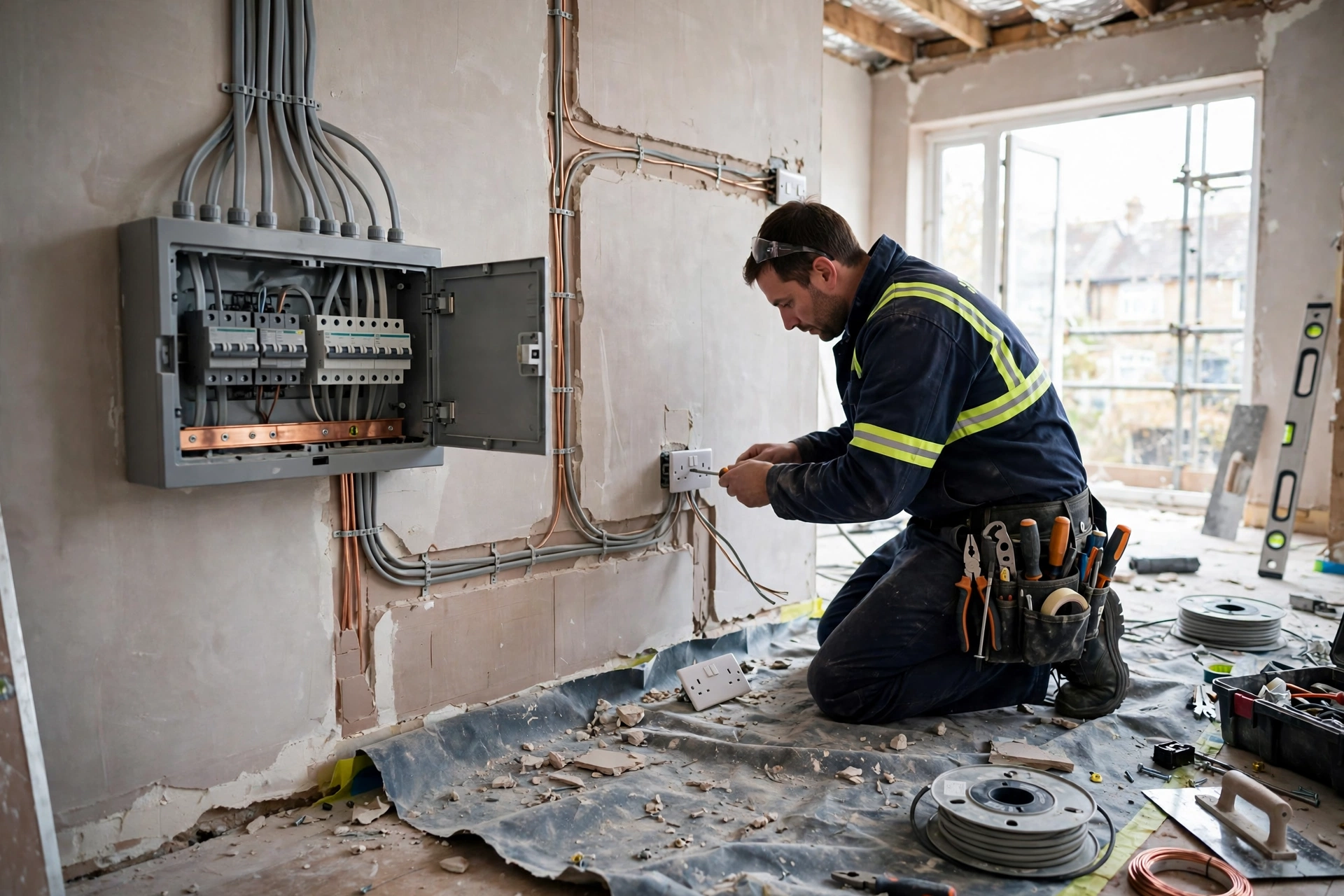
A house rewire is one of the most disruptive jobs a homeowner can take on, and also one of the most important. It replaces the old wiring hidden in your walls, floors and ceilings with new cable, new sockets and switches, and a modern consumer unit, and it ends with testing and certification that prove the work is safe. It is dusty, it takes days rather than hours, and it usually means replastering and redecorating afterwards. It is also the job that removes the nagging worry behind flickering lights, a fuse box with no RCD protection, and wiring that was installed before most of the appliances in your home existed.
This guide gives you the costs first, because that is what most people need before they decide anything else. It then explains the difference between a full and a partial rewire, the signs that your wiring actually needs replacing, what a proper quote includes, what it almost always leaves out, how long the work takes and what living through it is really like, and how to choose an electrician you can trust with it. Prices are typical UK guide ranges, not quotes. Your price depends on the size and age of your home, where you live, how easy the cables are to reach, and the specification you choose.
Costs by Property Size
The headline range for a full house rewire in the UK is about £3,000 to £12,500, depending on property size, with most three-bedroom homes falling between £4,500 and £8,000. That is the range given by Checkatrade’s house rewiring cost guide, updated in October 2026, and it is broadly matched by MyBuilder’s guide, which puts a full rewire at about £3,000 to £10,000. London and the South East typically add 15 to 25 percent to the national figures, because labour costs more there. Always check whether a quote includes VAT, because guides differ on this and a 20 percent difference on a £7,000 job is £1,400.
| Property | Typical full rewire cost |
|---|---|
| 1-bedroom flat | £3,000 to £4,800 |
| 2-bedroom flat or small house | £3,500 to £5,800 |
| 3-bedroom house | £4,500 to £8,000 |
| 4-bedroom house | £6,000 to £10,000 |
| 5-bedroom or larger house | £7,500 to £12,500 |
Smaller homes cost less in total but more per room. The consumer unit, the testing, the certification and the electrician’s set-up time cost much the same whether the house has six circuits or sixteen, so a one-bedroom flat never costs half as much as a two-bedroom house. Larger homes cost more because of longer cable runs, more sockets and light fittings, and more days on site.
Several things push a job above the typical range. A period property with solid walls, lath and plaster ceilings or limited access under floors takes longer to chase and make good. A home that is occupied during the work takes longer than an empty one, because the electrician has to leave safe, working circuits each night and protect furniture and floors. A high specification, with USB sockets, dimmers, smart lighting controls, outdoor circuits, an electric vehicle charger point or circuits for a future heat pump, adds materials and time. A listed building or a property in a conservation area can add cost through access and making-good requirements.
Get at least three itemised quotes, and compare them like for like. One quote may look cheaper because it includes fewer sockets, a basic consumer unit, or no allowance for chasing and making good, while another includes all three. Ask every electrician to price the same specification: the number of sockets and light points per room, the type of consumer unit, and whether the price includes testing, certification and Building Regulations notification. A quote that is far below the others is not a bargain. It is usually a sign that something has been left out.
Full vs Partial Rewire
A full rewire replaces all of the fixed wiring in the property: lighting circuits, socket circuits, cooker and shower circuits, the consumer unit, earthing and bonding, and every socket, switch and light fitting faceplate. It is the right choice when the existing wiring is old throughout, when an Electrical Installation Condition Report (EICR) has come back unsatisfactory in several areas, or when you are renovating anyway and the walls are already open. It is also the choice that gives you a clean start: one new installation, one set of certificates, and no old cable left behind walls to fail later.
A partial rewire replaces wiring in part of the property only, for example a single floor, a kitchen extension, or the circuits that failed an inspection. It costs less and disrupts less, and it makes sense when the rest of the installation is modern and in good condition. A kitchen partial rewire, for example, is common when a kitchen is refitted, because the old kitchen circuits cannot safely carry a modern cooker, induction hob and several high-load appliances. A partial rewire still needs testing and certification for the circuits that were changed, and the electrician should confirm that the new work is compatible with the existing consumer unit and earthing.
The risk with a partial rewire is paying twice. If the rest of the wiring is also near the end of its life, you may find yourself chasing walls again in a few years for the circuits you left alone. That is why an EICR is the right starting point. It tests the whole installation and reports which circuits are satisfactory and which are not, so the decision between full and partial is based on evidence rather than guesswork. An EICR typically costs about £150 to £300 for a typical house according to MyBuilder’s guide, and it is money well spent before a rewire quote, because it tells every electrician who quotes exactly what they are dealing with.
There is one job that is neither a full nor a partial rewire but is often confused with both: a consumer unit upgrade on its own. Replacing an old fuse box with a modern consumer unit with RCD protection improves safety, but it does not replace old cable in the walls. If the cable itself is deteriorating, a new consumer unit will not fix it, and it may trip more often because it is now detecting faults the old fuse box ignored. Ask the electrician to be clear about which job you are actually buying.
Signs Your Wiring Needs It
Wiring does not announce its age with a single symptom. It gives a pattern of small warnings, and the more of them you see, the stronger the case for an inspection, and then for a rewire if the inspection says so.
The first warning is the age of the installation itself. Rubber-insulated cable, used before the 1960s, is now well past its safe life and becomes brittle. Lead-sheathed cable and fabric-covered cable are older still. PVC cable from the 1970s onwards lasts longer, but a 50-year-old PVC installation in a house that has been extended, rewired in parts by different people, and loaded with appliances it was never designed for, is still a candidate for replacement. If you do not know when your home was last rewired, and the consumer unit still has rewireable fuses rather than circuit breakers, assume the wiring is old until an inspection proves otherwise.
The second warning is the behaviour of the electrics. Lights that flicker or dim when an appliance starts, sockets that feel warm, a burning smell near a socket or the consumer unit, buzzing from a switch, and circuit breakers or fuses that trip repeatedly are all signs of a circuit under stress or a loose connection. Scorch marks around a socket are a sign to stop using that socket and call an electrician promptly, not a cosmetic problem to paint over.
The third warning is a shortage of sockets and circuits for modern life. A house with one or two sockets per room, extension leads running under rugs and behind furniture, and a single ring circuit carrying a washing machine, a tumble dryer and a dishwasher, is overloaded by design. Extension leads are a temporary fix, not a wiring system, and they are a fire risk when they carry high-load appliances permanently.
The fourth warning is what an inspection finds. An EICR grades faults as C1 (danger present, immediate action), C2 (potentially dangerous, urgent remedial action) and C3 (improvement recommended). A report with C1 or C2 codes, or an overall unsatisfactory result, is a clear instruction to act, and a rewire is often the most economical way to clear several C2 faults at once rather than patching them one by one. A satisfactory EICR, on the other hand, is reassurance that a rewire is not needed yet, even if the installation is old.
Finally, a rewire is often triggered by an event rather than a symptom: buying an older property, a survey that flags the electrics, a renovation that opens the walls, or a change of use such as converting a loft or building an extension. In all of these cases, doing the rewire while the house is empty or already disrupted is far cheaper and far less painful than doing it later around finished decoration.
What Is Included: Consumer Unit, Certs and Part P
A proper full rewire quote should include more than cable and labour. If any of these items is missing, ask where it is, because you will need it before the job is finished.
The new consumer unit is the heart of the job. Modern units have circuit breakers for each circuit and RCD or RCBO protection, which disconnects the supply far faster than an old fuse if there is a fault or someone touches a live part. Surge protection is now commonly fitted as well, and it is worth asking whether your quote includes it, because a surge protection device adds a modest cost and protects sensitive electronics. The consumer unit should be labelled clearly, circuit by circuit, so you and any future electrician can see what each breaker controls.
The wiring itself includes new cable for lighting and socket circuits, new back boxes, sockets, switches and light fittings faceplates, and new circuits where the specification calls for them, such as a dedicated cooker circuit, a shower circuit, or an outdoor circuit. Earthing and bonding are part of the job, not an extra: the main earthing conductor, bonding to gas and water pipes, and supplementary bonding in bathrooms where required. If your home has old lead water pipes or a gas supply, the electrician should check the bonding as part of the rewire, because this is a common gap in older installations.
Testing is not a formality. The electrician tests every circuit for continuity, insulation resistance, earth fault loop impedance and RCD operation, and records the results. Those results go on the Electrical Installation Certificate, which is issued on completion of a new installation. You should also receive a Building Regulations compliance certificate, because rewiring is notifiable work under Part P of the Building Regulations in England and Wales. Part P requires electrical work in a dwelling to be designed and installed to protect people from fire and electric shock, and it requires the work to be notified to Building Control. In practice, an electrician registered with a competent person scheme notifies the work on your behalf and the compliance certificate arrives afterwards. Keep both certificates with your house documents. You will need them when you sell, and your insurer may ask for them after a claim.
One related point matters if you are combining a rewire with energy improvements. New circuits for a heat pump, solar panels or an electric vehicle charger have their own requirements, and cables run through loft insulation need to be sized for the reduced cooling the insulation causes. Tell the electrician about any energy work you are planning, even if it is a year away, so the consumer unit has spare ways and the cable routes allow for it. Our guide to improving your home’s EPC rating explains how electrical upgrades sit alongside insulation and heating changes when you are planning a home’s energy performance as a whole.
What Quotes Almost Always Exclude: Replastering and Decorating
This is the section that saves people from the commonest rewiring surprise. An electrician’s quote usually covers the electrical work: chasing out channels in the walls, running cable, fitting back boxes, installing the consumer unit, testing and certification. It usually does not cover putting your house back together afterwards.
Chasing means cutting channels into plaster to bury the new cable. Once the cable is in, the channel is filled, but the fill is not a finished plaster skim. Most electricians will make good the chases to a flat, fillable surface, and leave the wall ready for a plasterer. A full skim over walls that have been heavily chased, plus the redecoration that follows, is a separate trade and a separate cost. Guides put plaster making-good for a typical three-bedroom property in the hundreds to low thousands of pounds, depending on how much chasing was needed and whether whole walls need skimming, and full redecoration on top of that can match or exceed it. Get a plasterer’s view before the rewire starts, not after the electrician has left, so the total project budget is honest.
Other exclusions to check in writing include lifting and refitting carpets and floorboards, moving heavy furniture, repairing floorboards that have been lifted for cable runs, and making good ceilings where cables have been run above them. Some electricians include basic making good and floorboard refitting, and some do not. The difference between two quotes is often in this paragraph rather than in the price of cable.
Also check who is responsible for the finish of the chases around sockets and switches, and whether the quote includes new faceplates throughout or reuses the old ones. A new installation with old, yellowed faceplates is a false economy, and most full rewires include new faceplates as standard. If yours does not, ask for them to be added.
Budget for the whole project, not just the electrical quote. A realistic total for a three-bedroom house is the electrical cost in the table above, plus plastering and decorating, plus a contingency of about 10 percent for the things that only appear once walls are opened, such as a hidden junction box, a damaged joist, or a circuit that was wired in a way nobody expected. Older houses always hide something. A contingency is not pessimism. It is how you avoid a half-finished job.
Timescales and Living Through It
A full rewire of a typical three-bedroom house takes about 5 to 10 days on site for the electrical work, according to the UK guides, with smaller flats taking 3 to 5 days and larger houses 10 to 14 days or more. That is the electrical work only. Plastering needs drying time after it, and decorating follows that, so the full project from first chase to last coat of paint is usually several weeks. The guides agree on the pattern even where their day counts differ slightly: the electrical phase is the fast part, and the making good is what stretches the calendar.
Living in the house during a rewire is possible, and many people do it, but it is not comfortable. The electrician works room by room, and each room is out of use while it is chased and wired. Power is off in parts of the house during the day and restored, where it is safe to do so, each evening. Dust gets everywhere despite sheeting, because chasing plaster creates fine dust that travels. Noise starts early and continues through the day. If you work from home, plan to be elsewhere during the noisiest days, and if you have young children or anyone in the house with a health condition affected by dust, consider moving out for the chasing phase at least.
Practical preparation makes a real difference. Clear every room of furniture or move it to the centre and cover it. Take pictures and mirrors off the walls. Agree with the electrician in advance where the new sockets and switches will go, room by room, because moving a socket after the chase is cut costs time and plaster. Mark the positions on the wall with tape if it helps. Decide where the consumer unit will sit, and check that it is accessible without moving a wardrobe. Agree the working hours, the parking, and where waste will go. A rewire generates rubble and old cable, and the old cable has scrap value, so agree in advance whether the electrician takes it away or leaves it for you.
If you can, time the rewire to coincide with other disruptive work. Rewiring before a new kitchen or bathroom is fitted, before a loft conversion, or before a full redecoration means the chasing damage is covered by work that was happening anyway. Rewiring after a new kitchen has just been fitted means removing and refitting units to reach the walls behind them, which is wasteful. Sequence matters, and it is worth a conversation with your builder or kitchen fitter before the electrician starts.
After the electrical work, the house needs to dry. Fresh plaster and filler need time before they can be painted, and painting over damp plaster causes peeling. If the walls smell musty or show dark patches that do not wash away, check for damp before you paint rather than covering it. Our guide to types of damp in a house explains how to tell condensation, rising damp and penetrating damp apart, because each needs a different fix and none of them is fixed by paint alone.
Choosing an Electrician: NICEIC and NAPIT
A rewire is notifiable, safety-critical work, and the person who does it matters more than the price difference between two quotes. In the UK, the two main competent person schemes for domestic electricians are NICEIC and NAPIT. An electrician registered with either scheme can self-certify the work under Part P and notify Building Control on your behalf, which is what produces your compliance certificate. Registration is not a guarantee of quality on its own, but it is a minimum filter, and you should not use an unregistered electrician for a full rewire unless they are arranging Building Control notification directly, which is slower and more expensive for you.
Check the registration rather than taking it on trust. Both NICEIC and NAPIT have online registers where you can search by company name or registration number, and you can ask to see the electrician’s registration card on site. Check that the registration covers the scope of your job, and that the person doing the work is the registered person or is supervised by them. A company can be registered while the person who turns up is not, and that distinction matters if there is a problem later.
Ask for references from recent rewires of a similar size, and if possible, speak to one of those customers about dust, disruption, timescales and making good, not just about the electrics. Ask whether the electrician provides a written, itemised quote, a start date, a realistic finish date, and a written guarantee for the work. Ask what happens if a fault appears in the first year, and who you call. A good electrician will answer all of this without hesitation, because they answer it every week.
Be wary of the warning signs that appear in every trade: a quote given without visiting the property, a price that is far below every other quote, pressure to pay a large deposit in cash, no written terms, and no mention of certification or Building Control. A deposit for materials is normal, but it should be a reasonable proportion, paid by a traceable method, and recorded in writing. The final payment should be due after testing, certification and a walk-through of the finished work, not before.
Finally, keep the paperwork. The Electrical Installation Certificate, the Building Regulations compliance certificate, the test results, and the quote and invoice together form the record of your new installation. File them with your other house documents, and give a copy to your solicitor if you sell. A documented rewire is a selling point. An undocumented one is a question a buyer’s surveyor will ask, and a reason for a buyer to renegotiate.
Frequently Asked Questions
How much does it cost to rewire a 3-bedroom house in the UK?
Typically £4,500 to £8,000 for the electrical work, according to Checkatrade’s October 2026 guide and MyBuilder’s guide. That figure usually excludes replastering and redecoration, which are separate costs, and it rises by about 15 to 25 percent in London and the South East.
How long does a full house rewire take?
About 5 to 10 days on site for a typical three-bedroom house for the electrical work, with smaller properties taking 3 to 5 days and larger ones 10 to 14 days or more. Plastering and decorating afterwards extend the full project to several weeks.
Do I need to move out during a rewire?
No, but many people choose to, at least for the chasing phase. Power is restored in safe sections each evening, but dust, noise and rooms out of use make living in the house uncomfortable. Moving out is worth considering if you work from home or have young children in the house.
Is a rewire covered by Building Regulations?
Yes. Rewiring is notifiable work under Part P of the Building Regulations in England and Wales. A registered electrician (NICEIC or NAPIT) notifies the work on your behalf, and you should receive an Electrical Installation Certificate and a Building Regulations compliance certificate when the job is complete.
What is the difference between a full and a partial rewire?
A full rewire replaces all fixed wiring, the consumer unit and all faceplates. A partial rewire replaces wiring in part of the property, such as one floor or a kitchen. A partial rewire makes sense when the rest of the installation is modern and satisfactory, which an EICR can confirm.
Does a rewire include replastering and decorating?
Usually not. Most electrical quotes cover chasing, wiring, the consumer unit, testing and certification, and making good the chases to a fillable surface. Full plaster skimming and redecoration are separate trades with separate costs, so budget for them in addition to the electrical quote.
How do I know if my house needs rewiring or just an EICR?
Start with an EICR, which typically costs about £150 to £300. If it comes back satisfactory, a rewire is not needed yet. If it is unsatisfactory, with C1 or C2 faults across several circuits, a rewire is often the most economical way to put the installation right.
Will a rewire increase my house value?
A documented rewire with certificates removes a common survey objection and reassures buyers and insurers, which helps a sale, but it is best treated as a safety and compliance investment rather than a guaranteed return. The value is clearest when the old installation was a known problem, for example rubber-insulated cable or a fuse box with no RCD protection.